


From the ISET Economist Blog (https://www.iset.ge/blog/?p=3311)
By Eric Livny
(Summary of a debate hosted by ISET as part of SDC-supported Inclusive Growth Dialog series.)
There are many reasons to love the concept of farmer cooperation (and cooperation more generally). To begin with, there is a great aesthetic value in seeing people coming together, sharing resources and helping each other. After all, instinctive collectivism was the basic condition of human existence from time immemorial. But, there are also powerful economic reasons for farmer cooperation.
Smallholders are often too small to independently access markets, and can be easily exploited by middlemen and local monopolies. Service cooperatives can increase the bargaining power of smallholders versus banks, service providers, input suppliers, processors and … government. This light form of cooperation is quite effective and relatively easy to manage and sustain, which explains its prevalence in North America and Western Europe.
A more ambitious (and far more demanding) form of cooperation is about pooling fragmented smallholdings into larger farms. Examples of such production cooperatives are the Israeli kibbutz and Soviet collective farms. These are said to benefit from economies of scale in primary agricultural production.
Yet, despite its aesthetic value and compelling economic reasons, farmer cooperation (of both types) has been a spectacular failure in many transition economies, and particularly on the territory of the former USSR, including Georgia. In the words of Tim Stuart, development practitioners in the post-Soviet space are often confronted “with the reality of failed farmer groups that evaporate once the project ends, with unused equipment rusting in the corner of a field, an image, which has become a cliché of dysfunctional development in the popular press. And for many people engaged in development, farmer groups are a byword for failure.”
Of course, failure and success are terms to be defined relative to expected results. For the likes of Juan Echanove, coordinator of EU’s ENPARD program, the journey of a thousand miles in farmer cooperation begins with a single step. His expectation is that the dramatic changes in the legal and financial context for agricultural cooperation in Georgia will encourage the creation of bottom up farmer organizations based on traditional forms of mutual help and resource sharing that have always existed in Georgia. According to Juan, Georgian farmers have been always establishing informal groups and associations, in many cases without any external support and by their own initiative. Such groups often focused on a very narrow but functional scaling up of everyday economic activities including joint arrangements for pasture management and feeding, livestock management, collective work on plowing and harvesting, etc.
WHO IS TO TAKE FARMER COOPERATION TO THE NEXT LEVEL?
While bottom up cooperation may indeed flourish in the new policy context, there is agreement among all analysts that for farmer cooperation to move to the next level – beyond its primitive forms – Georgian villagers have to be provided with the prerequisite skills and resources. A related question, posed by Simon Appleby, an Australian agronomist and agribusiness consultant with many years of experience in South East Asia and Georgia, is “If development agencies are the “wrong” people to be involved in farmer groups and co-ops, who are the “right” players to be involved?” To his mind, “while it may be jarring to the collectivist sensibilities of some, it is worth looking at corporations as enablers and incubators of co-ops.”
Indeed, Juan sees a very wide spectrum of possibilities for private sector involvement, with or without donor assistance. For instance, some farmer groups will emerge to gain access to better and/or cheaper inputs (fertilizers, seeds, fuel) or services (mechanization, vet services, artificial insemination). In these cases the key business partners are not the buyers of the products, but providers of services and inputs. And, importantly, donors – ENPARD, and USAID’s REAP program – will target these businesses rather than farmer groups.
Juan is quick to admit that the issue becomes trickier if the goal is to create farmer groups jointly selling their primary products. Anyhow, even in this case there will be groups such as mandarin or hazelnut co-ops who will face no problem selling their products to a myriad of middlemen, processors and exporters. If these coop do things the right way, argues Juan, they will have more or better quality product to sell. The buyers are already there, and farmer groups won’t need any help in engaging with the private sector.
Finally, there will be co-ops directly placing their products in the local markets, and there is nothing wrong with that, according to Juan. Producing more and/or at a lower cost in the nearby town marketplace would be an easy and realistic improvement. In many parts of Georgia there is simply no alternative, and we don’t always have to be looking for complex solutions.
One problem with Juan’s arguments, however, is that in none of the simple cases private sector actors would have the incentive to provide Georgian villagers with the skills and resources to do things the right way and to manage cooperation. For instance, while input providers would be quite interested in marketing their products (e.g. fertilizer) to individualfarmers, there is no advantage for them in helping organize and train groups of farmers who, once organized, i) would be much tougher to negotiate with and ii) could switch to competing providers. For exactly the same reason, no single buyer of hazelnuts or mandarins would invest time and effort to help organize and train farmer co-ops even though it may be more convenient for him/her to deal with larger and more reliable growers.
Thus, while businesses may be the (only) right players to be involved in enabling and incubating farmer co-ops, special government or donors schemes would have to be developed to incentivize potentially interested corporate actors. While costly, such schemes could be justified if the resulting supply chain relationships have the potential to be sustained without additional subsidies beyond the necessary period of incubation.
As Simon Appleby explains based on his experience in South East Asia, the government could compel large food processors to take on co-ops as supply chain partners. Government (and donors) could also use carrots, such as tax holidays, low interest loans, or grants. That said, there would be no need for the government to play an active role in micromanaging farmer groups. With corporations providing suppliers with a comprehensive support package (finance, inputs, training, and guaranteed forward contracts), co-ops would pop up in response to business opportunities. Given their small size (3-5 families) and blood or friendship bonds on which they are often based, internal management issues of typical co-ops would not be very complicated. According to Simon, over time co-ops could diversify their activities from basic post-harvest treatment, storage, and logistics, to deep processing, foodstuffs trading and financial services, but this process may take many decades. Rushing the process, however, carries huge operational and financial risks.
THE CASE OF TKIS NOBATI
The challenge of incentivizing corporations to integrate smallholder co-ops into their supply chains is not a trivial one. Mind it that corporations – e.g. large processors – have other options. They can choose to go it alone by developing own supply base or contract large farms that don’t need incubation, and can be trusted to deliver on time and in consistent quality.
Yet, as one can also learn from the recent Georgian experience, there would be situations in which businesses have the incentive to engage in nurturing formal or informal farmer groups. While exceptional, these situations provide an excellent sense of the underlying economics.
In 2008, upon graduating from ISET, Gaga Abashidze has taken over a small family business which has been for years buying and processing rose hips gathered by Georgian villagers in the Shida Kartli region. The business model was extremely simple. Villagers harvested and delivered the fruit. Gaga processed and exported rose hip juice to Europe and Japan. Villagers saw no advantage in cooperation, and Gaga saw no need to engage them as a group.
Things changed when Gaga “discovered” the lucrative market of organic rose hip products, which required adopting a more complicated business model. First and foremost, moving to organic production required certifying all stages in the process, from harvesting to post-harvest treatment/storage to processing. Now, as Gaga quickly understood, there was simply no way to certify hundreds of villagers. To acquire international organic certification his supplier had to be a legal entity which could be trained and certified. Of course, once incorporated, his supplier could also come into possession of necessary equipment, contributing to the efficiency of harvesting, post-harvest treatment and storage, reducing processing costs and improving the quality of the final product.
Gaga had two options of re-organizing his supply chain: help create, and work with, a farmer organization, or expand own business. In weighing these two options, Gaga chose the farmer organization/outsourcing alternative for two main reasons.
- Many of the startup costs could be shouldered by the village community, including labor and land. While there was little to be saved in labor costs by hiring own workers, the co-op could be eligible for donor assistance to offset capital, training and certification costs.
- Gaga knew that the co-op would be a reliable business partner. On the one hand, he had a long history of working with individual members of the group and trusted its leadership. On the other, having access to a lucrative export market he could afford paying a premium for organically certified rose hips, essentially killing any incentives for the group to switch to a different buyer. As much as Gaga needed the group to supply him with a certified product, the group needed him to gain access to the organic export market. Thus, both parties were to be locked into a sustainable win-win relationship.
This particularly account of Tkis Nobati, a small Georgian cooperative in the vicinity of Saguramo is not meant to detract from the role of other players (e.g. the Regional Communities Development Agency, which channeled donor funding, and Elkana, which assisted in the bio-certification process). Rather, the point is to draw attention to the economic rationale for private sector engagement with Georgia’s budding agricultural co-op movement.
The most important insight to be gained from the exceptional story of Gaga Abashidze and Tkis Nobati cooperative is that while the costs of private sector engagement in incubating smallholder “supply” co-ops could be subsidized by donors or governments in the short term, supply linkages thus created are likely to be quite fragile. In the presence of alternative suppliers, co-ops would have to be very well managed to maintain consistent quality and reliability. Otherwise, we may see many more disturbing images of “equipment rusting in the corner of a field”.
To conclude, farmer co-ops can indeed serve many different purposes. Yet, significantproductivity improvements in Georgia’s agricultural sector would only be possible on the basis sustainable supply relationships between farmers and downstream processors and retailers. Only such linkages (embodied in explicit or implicit forward contracts) can provide the basis for new technology adoption and investment.
As Georgia starts exporting to new markets—to Europe under the DCFTA, for example—there will be stronger incentives for smallholder farmers to come together in order improve product quality and achieve market access. Cooperatives and farmer associations may certainly provide the organizational vehicles to take advantage of new export opportunities. Additionally, however, the Georgian parliament and government may want to consider amending the Law on Cooperatives in a manner facilitating corporate involvement in the creation of smallholder co-ops. For example, corporations could be allowed to acquire a stake in co-ops (or “smallholder partnerships”) in return for investment in commonly managed storage or processing facilities.
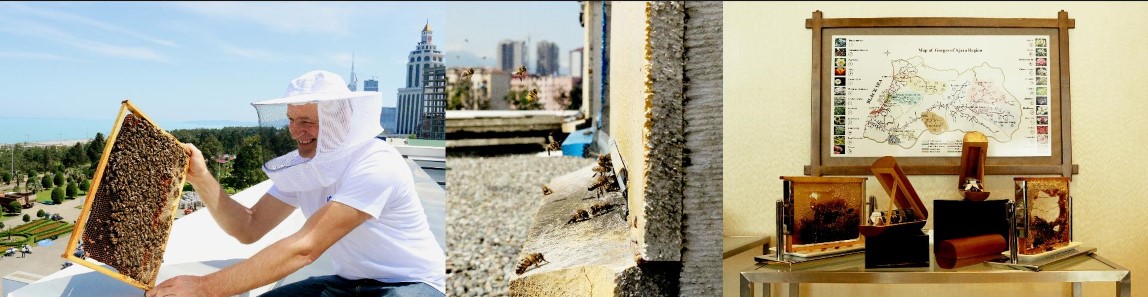
4 Beehives and their inhabitants from the high mountains of Ajara started their new life on the terrace of one of the largest Hotels in Batumi, Georgia, the Hilton Batumi, to produce honey for hotel guests. The General Manager of the Hilton, a keen birdwatcher and conservationist had the idea, seeking to showcase the beautiful countryside of Ajara and take this first step in illustrating the story of locally sourced food and the people who produce it.
By linking the hotel with the Ajara Beekeepers Business Association, the hives were installed. Urban beekeeping is increasingly popular in Europe as bee colonies decline and new ways are sought to develop a more ecologically sensitive lifestyle as urban centers grow. The Hilton also installed a honey showpiece at the breakfast buffet, of mounted honey comb, a large map of the 10 honey production gorges of mountainous Ajara and the indigenous flora on which the bees feed with the honey and comb sourced through honey producing company Matchakhela Ltd.
These initiatives which form a part of the ALCP programme’s work in the honey market system illustrate the great potential of the honey sector to feed into the promotion of Ajara as a great and varied tourist destination.
Income received from the Hotel hives will be donated to children in need in the rural municipalities.
News travels fast and perhaps other hotels may take up the initiative now it's been advertised through the Hilton chains newsletter.
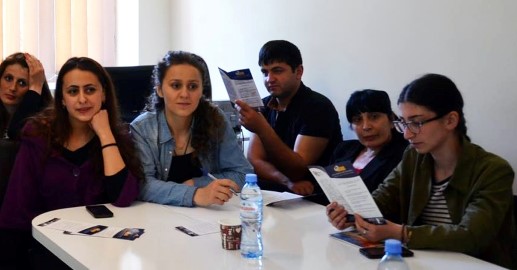
Khelvachauri Women’s Room is taking its first steps in helping women access public resources voice their opinions and participate in local self-governance. The Women’s Room model that is being replicated in Ajara was first established in three municipalities of Kvemo Kartli from 2012 and subsequently in all municipalities of Kvemo Kartli and Samstkhe-Javakheti. The first opened in Batumi with the Association of Business Women of Ajara (ABWA) in the Ajara Chamber of Commerce and Industry (ACCI) was the first of all a new type of urban and business based women’s room, with the ideas of providing business trainings and an urban connection for the municipality based women’s rooms already opened in Keda, Shuakhevi, Khulo and Khelvachauri municipalities and soon to open in Kobuleti. The rooms are proving popular with these WR’s already providing more than 1200 services in three months.
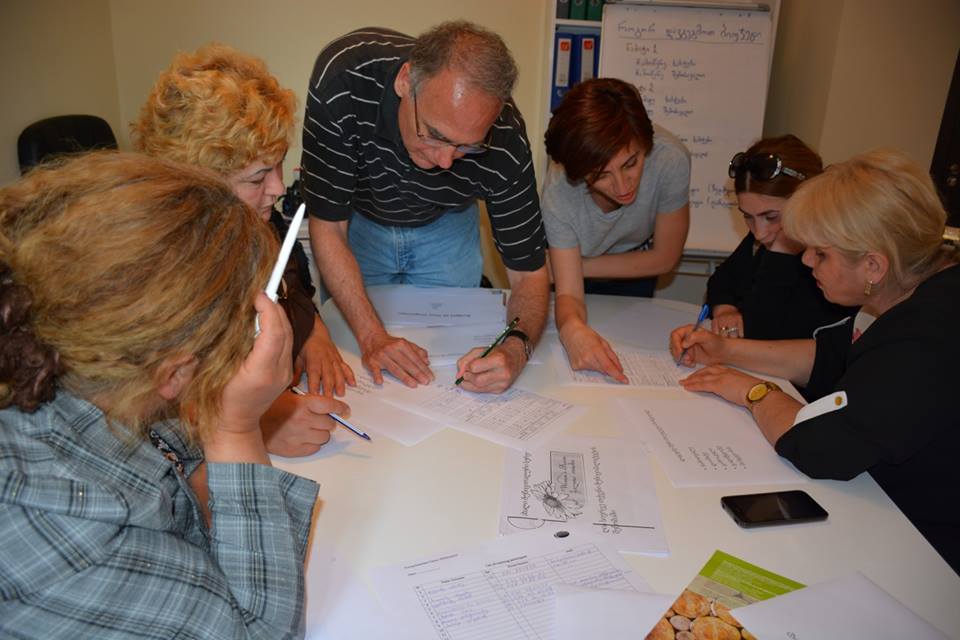
The Women’s Rooms are a municipal service, a resource and consultancy space for facilitating open dialogue between local society and municipality officials, aiming at promoting women’s participation in the decision-making at the local level and increasing their access to municipal information and services including on health care and agricultural programmes. Women’s Rooms also offer a platform for trainings and meetings, supporting new initiatives and instilling women’s active participation. The space has been taken up quickly with the Association of Young Lawyers and the School of Democracy using the rooms to raise women’s awareness on human rights, economic and educational opportunities. Visitors can use library and internet for free. All of the Women’s Rooms in Ajara are easy to access on the first floor of municipality buildings and can be freely used by people with disabilities for meeting with Gamgebeli and other officials to speak about their issues. Gamgebelis hold weekly meetings with local citizens in the W’s Rs. A Free hotline number (Khulo 0 800 100 109; Shuakhevi 0 800 000 008; Keda 0 800 100 103; Khelvachauri 0 800 100 106) allows rural women to voice their issues in the Gamgeoba.
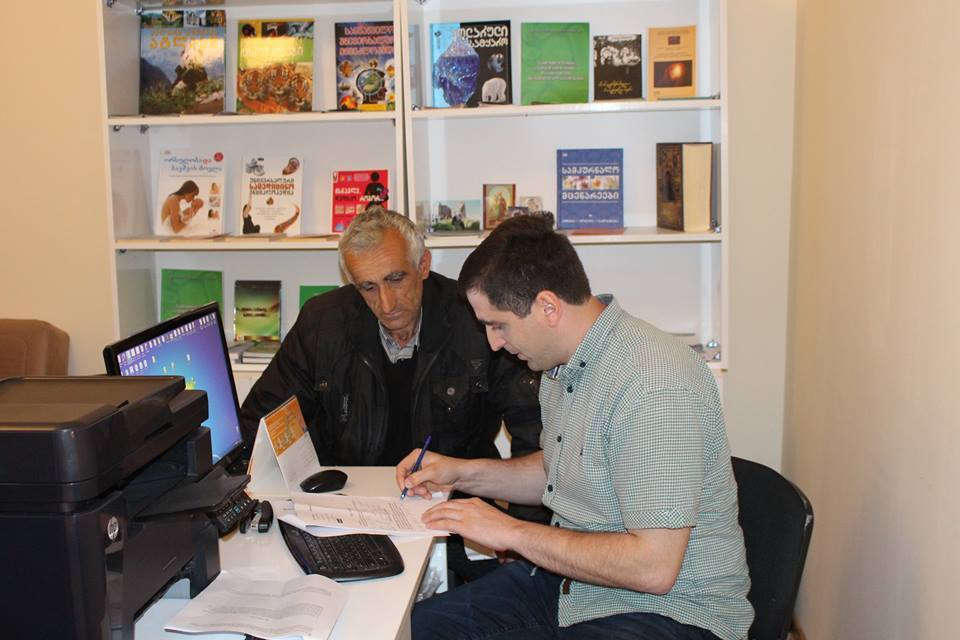
Women’s Room coordinators and municipal Gender Advisors, were trained on the importance of women involvement in decision-making using guidelines on The Application and Implementation of the Law on Gender Equality of Georgia by local self-government bodies to increase women’s participation in the community meetings, that was resulted in significant increase from 3% (2014) to 33% (2016) of women’s participation in these meetings.
To find out more about W’s Rs ongoing activities, visit Ajara (Batumi,Khulo, Shuakhevi, Keda, Khelvachauri), Kvemo Kartli (Dmanisi, Tsalka, Tetritskaro, Rustavi,Marneuli, Aspindza) and Samtskhe Javakheti (Akhaltsikhe,Adigeni, Borjomi ) W’s Rs Facebook pages.
Posted by Helen Bradbury: Team Leader, Alliances Lesser Caucasus Programme


ALCP has been featured on BEAM Exchange. See the story below.
Rural farmers can only grow their income when they have access to the drugs and veterinary services to keep their animals healthy and growing too. Alliances has partnered with a national veterinary inputs supply company to improve access to drugs, information and vet services for poor farmers in rural Georgia. There are strong signs competitors are seeking to replicate the model, which is also scaling up nationally and in neighbouring countries.
The challenge
Over 2 million people in rural Georgia rely on subsistence farming, typically owning less than one hectare of land. SDC has been funding a series of programmes in Southern Georgia since 2008 to improve the livelihoods of livestock farmers.
During initial surveys, Alliances learned that less than 10 per cent of farmers were accessing veterinary drugs or services in their community, in rural vet pharmacies mainly self-stocked from trips to Tbilisi. Others bought drugs when travelling to the capital. In the rural vet pharmacies a limited range of often improperly stored drugs were sold at high prices due to the resultant transaction costs. Local advice was minimal, unavailable or out of date. This had led to a lack of farmer trust in local veterinary products and services and unwillingness to invest.
Suppliers had failed to grasp the market potential of developing rural distribution, lacking both the information and capital to do so. The uncertainty about whether farmers would buy their products meant the perceived risk held suppliers back from making the first move.
Name: Natural Produktsia Ltd
Place: Dioknisi Village, Khulo Municipality
Type of business: Cheese Factory
Product: Imeruli Cheese
Suppliers: about 450 women from 13 villages of Khulo
Current production per day: 5 tons of milk (700 kg of cheese)
The Problem
The 450 women now selling milk directly to the milk collectors of the Natural Produktsia Ltd Factory in Dioknisi, Khulo used to make cheese from their milk. Women are responsible for milking the household cattle and making the cheese, butter, sour cream and cottage cheese which is then sold as an important part of the family’s livelihood.
Selling these products however is hard and uncertain. The journey by marshutka to Batumi Agrarian Market can take up to 4 hours on bad roads. It is taken to the market by husbands or other male family members or sent with the driver and met by a relative who then tries to sell it. There is no guarantee of a sale and often the family is forced to accept a low price from the market vendors rather than take it home again.
“Women in Georgia – Tradition and Contemporaneity” is a short documentary film prepared by ‘Netgazeti’ (online newspaper) about women living in Ghordjomi Community (Khulo Municipality, Ajara). Ghordjomi is one of the largest Muslim communities in Ajara and is known for its early marriage traditions, and other strict rules and attitudes towards women. The film describes the harsh daily routine of the women starting from 6 am in the morning with taking care of the cattle, children, household and the restrictions they face in daily life.
The ALCP AJ programme’s Focus Group Survey and Gender Analysis captured these issues and also noted the consequent effect on the participation of women in the decision-making processes at the community and local governmental levels which is chronically low.
From the ISET Economist Blog (https://www.iset.ge/blog/?p=4633)
By Eric Livny
The “do no harm” (primum non nocere) principle is well known to students of medical schools. It is one of the most fundamental maxims in medicine, as formulated, for example, in the Epidemics book of the Hippocratic Collection:
“The physician must … have two special objects in view with regard to disease, namely, to do good or to do no harm“.
Doctors are taught that medical interventions are not risk-free. Thus, when facing a “problem” one should consider whether to use a particular procedure (e.g. surgery or chemical treatment) or do NOTHING.
Not surprisingly, this very principle has applications in many fields other than healthcare. And it is high time for this principle to be studied and applied in Georgian policymaking.



