



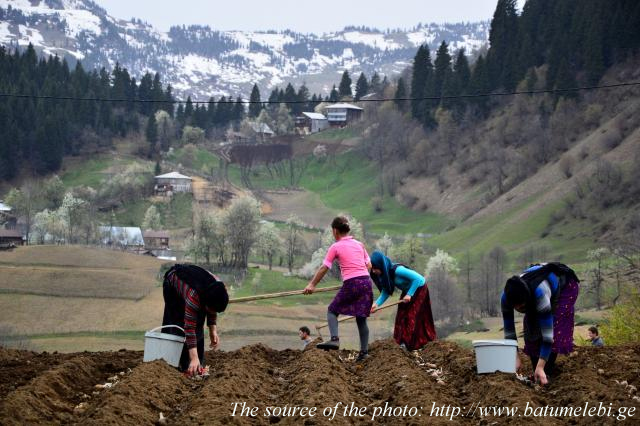
“Women in Georgia – Tradition and Contemporaneity” is a short documentary film prepared by ‘Netgazeti’ (online newspaper) about women living in Ghordjomi Community (Khulo Municipality, Ajara). Ghordjomi is one of the largest Muslim communities in Ajara and is known for its early marriage traditions, and other strict rules and attitudes towards women. The film describes the harsh daily routine of the women starting from 6 am in the morning with taking care of the cattle, children, household and the restrictions they face in daily life.
The ALCP AJ programme’s Focus Group Survey and Gender Analysis captured these issues and also noted the consequent effect on the participation of women in the decision-making processes at the community and local governmental levels which is chronically low.
The programme employs a systemic approach in which gender mainstreaming is integral to ensuring equitable impact. To date interventions have included:
- A Memorandum of Understanding with Ajara’s self-governments to cooperate in the gender related issues and to support implementation of the Law on Gender Equality of Georgia.
- Facilitating the appointment of Gender Advisors in all five municipalities of Ajara
- Organized training for the Advisors on how to increase women participation in community meetings. Following the training, Gender Advisors worked with Village Representatives and as a result the attendance of women in the community meetings has increased by 10-15 %.
As the follow up to these activities, the programme will further ensure women’s access to decision-making and public goods and information by establishing a municipal service the ‘Women’s Room’ in the municipalities of Ajara region.
Another constraint captured by the Gender Analysis is that female farmers lack information regarding livestock husbandry, again due to the several cultural, ethnic and social constraints. Programme facilitated training on cow’s reproduction cycle for the female SSLPs in eight villages of the five municipalities of Ajara region, where intervention of the improved bull services is on place.
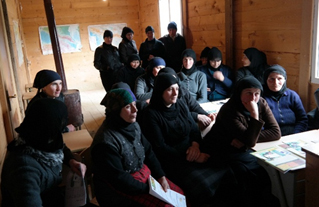
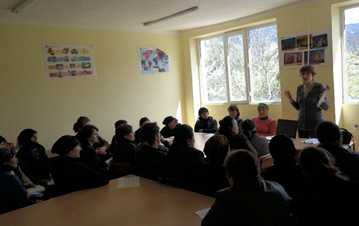
The main subject of the training was a heat detection followed by other issues concerning breeding, veterinary, nutrition, etc. This type of information is important for women, as they are mainly responsible for identifying the right time for cows to breed, however they feel uncomfortable to ask questions to the vets who are mostly men. Therefore, the female experienced vet and AI practitioner, Nana Balanchivadze was invited to carry out the trainings.
The female farmers expressed their interest and emphasized necessity of the female vets’ involvement in the veterinary matters. The participants were mostly interested in the reproduction cycle, symptoms and treatment of the cattle diseases. Overall, 108 women were trained. In addition, 42 men also asked trainer for advice on breeding and veterinary.
Armenians have been living in Kvemo Kartli for centuries. According to the 2002 census 31,777 out of 497,530 Kvemo Kartli residents were Armenians. The number of Armenians is highest in Tsalka where 11,484 Armenians live, out of a total population of 20977. The advent of Armenians in Georgia was related to the movement of people during the Arab, Turk-Seljuk, Mongolian, Turkmen, Kizilbash, Ottoman Turk and other invasions. Several major settlements of Armenians took place in 1828-1829, during the Russian-Turkish war
Azerbaijanis living in Kvemo Kartli are Turkic-speaking people representing the legacy of the conquerors that came to this area at different times. in the 1926 Census they were referred to as Azerbaijanis. The Azeri population that settled in Kartli is comprised of two streams of migrants: 1. The Turkish-speaking population that was resettled between 15th-18th centuries; they went through the heaviest psychological and physical stress before they adapted to the new place. 2. Migrants who moved from one place to another to improve living conditions having adapted to the new environment. Currently the Azeri population in Georgia numbers 224,606. They mainly reside in Bolnisi, Dmanisi, Gardabani and Marneuli districts, mostly in district centers apart from in Dmanisi muniiciaplity where there are many Azeri villages. Some live in Tetritskaro and Tsalka districts.
In 1980’s the planned settlement of a large groups of eco-migrant Ajarians and Svanetians started in Tetritskaro and Tsalka municipalities. There were several streams of eco-migration up to 2003. The advent of these incomers has left its mark on Kvemo Kartli. It became richer from an ethnic, religious and language standpoint, however it also gave rise to new problems and challenges for new and old residents alike in seeking to adapt to the new cultural diversity.
The first settlement of Svans into Kvemo Kartli took place in 1987. This is when the Svans from landslide-affected Chviberi (higher Svaneti) were resettled in Dmanisi, in the houses built under a government programme. Svans started to introduce their style of life in Kvemo Kartli and establish strong communities in Kvemo Kartli.
In 2011 Alliances KK facilitated establishment of DRR Municipal Working Groups in Dmanisi, Tsalka and Tetritskaro municipalities. These groups remain to be the main point for planning and implementing of prevention measures to reduce livestock related disaster risks.



