



In 2011 Alliances KK facilitated establishment of DRR Municipal Working Groups in Dmanisi, Tsalka and Tetritskaro municipalities. These groups remain to be the main point for planning and implementing of prevention measures to reduce livestock related disaster risks.
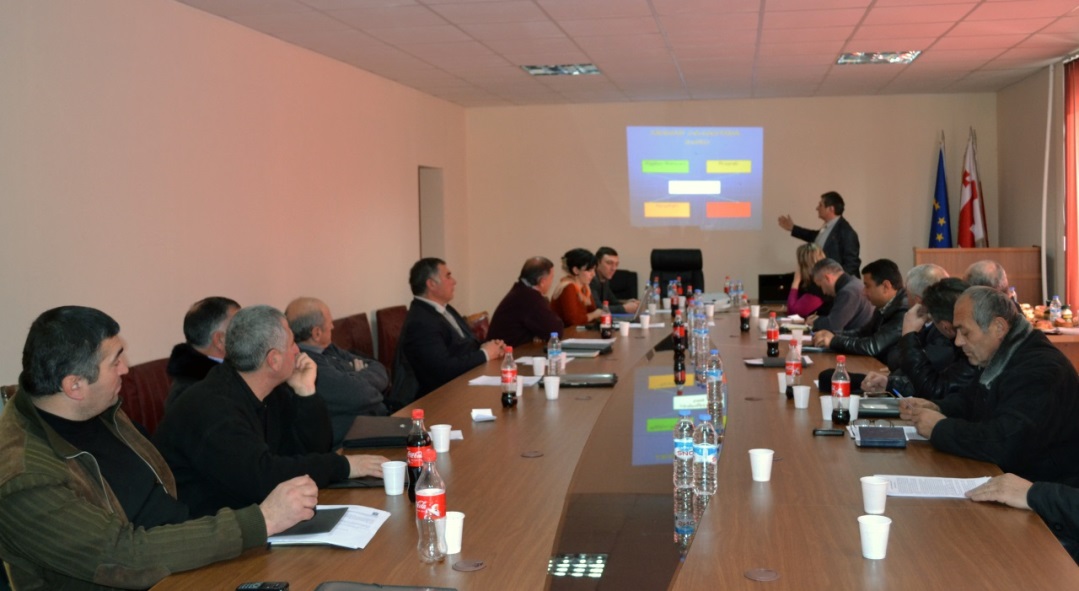
The expert in DRR issues – Temur Melkadze was invited by Dmanisi self-government to conduct the training for the Municipal Working Group and Village Reps on December 11th. The purpose of the meeting was to improve the knowledge of DRR Working Group Members and Village Reps about the following topics:
- General Overview and Classification of Disaster
- The Concept of Emergency Situation and its Management System in Georgia
- The Legislation and the Role of the Self-Government During Emergency Situations
About 20 participants of the training were provided with appropriate reading materials for gaining more detailed information on above listed topics.
Dmanisi municipality continues working for increasing awareness on DRR related issues and in terms of it the self-government is planning to invite the NFA Representative to lead the training on Animal Disease Control and Quarantine Arrangements for DRR Municipal Working Group.
In October 24th the first flocks of migrating animals went through the newly arranged bypass route in Tsintskaro village, Tetritskaro Municipality. Testing of the new route was carried out successfully - sheep, cattle, horses, donkeys, dogs and shepherds passed on the new road without any difficulties. The movement was monitored by the Tetritskaro Municipality DRR WG members and the Tsintskaro village Rep.
For scaling up DRR facilitation of Local Self Governments by the programme the meeting was held with the Governor of Kvemo Kartli - Ramin Ismailov.
From the ISET Economist news (http://www.iset.ge/news/?p=3871)
By Eric Livny
Democracy and Freedom Watch reported October 9, that “Georgia’s controversial new immigration law may be changed”. The law, writes DFW, “has caused a wave of confusion and irritation in the country’s expat community. Prime Minister Irakli Gharibashvili … told journalists that if any defects become apparent after the enactment of the new law, ‘we’ll surely correct it.''
By Helen Bradbury: Team Leader, Alliances Lesser Caucasus Programme


Information matters, it is our currency, the substance, the commodity which keeps our programmes running. We live in an age of information, are afloat on and sometimes drowning in a sea of it. We may check the oracle of google in answer to any question, live feeds, notifications and a torrent of minutiae in a mélange of events of great importance, continually assail us. Once there were spin doctors, now most of us spin daily be it personally or professionally. We are aware of the need to manage information, to have enough of it and of the right kind and most of us are aware too of the need to understand its quality and to know when and what we have is enough or too little.
The villagers of Tsintskaro village have suffered for years from the twice yearly flow of more than 100,000 sheep, cattle, goats, donkeys, horses and shepherd dogs straight past their gates. The problem has been in impasse for years with no real ownership of the issue by the myriad actors involved. Now, the local government has spearheaded the movement to solve the problem calling together support from a group including the MOA, MOE, the Regional Government and Shepherds Association which has been working for three years to improve coordination and bring the matter of the Animal Movement Route to public attention.
Drought is one of the critical disaster issues being typical for Kvemo Kartli and significantly harming agricultural sector in the region. Severe drought that occurred in this area in July-August, 2014 has negatively affected livestock husbandry which resulted with the reduced milk yield, hay production and deteriorated pastures in Kvemo Kartli.



