



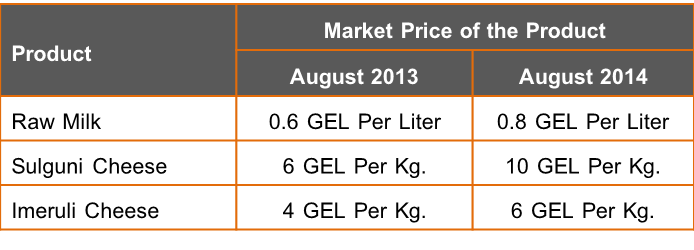
Drought is one of the critical disaster issues being typical for Kvemo Kartli and significantly harming agricultural sector in the region. Severe drought that occurred in this area in July-August, 2014 has negatively affected livestock husbandry which resulted with the reduced milk yield, hay production and deteriorated pastures in Kvemo Kartli. These factors have rapidly impacted on raw milk and dairy product prices as well:
As climate conditions are among the main determinants of hay harvest, this summer has not been conducive for hay making. According to the information provided by Ednar Antadze (livestock nutrition service provider) if in average the number of bales harvested per ha is - 150, because of severe drought this year farmers managed to get only about 120 bales per ha. Despite the increased demand, the prices on hay have not yet changed and remain 5-6 GEL per bale – same as last summer.
Baqar Papashvili, the Head of Agriculture Development Unit of Tetritskaro Municipality: “Severe drought has brought a huge loss to the farmers in our municipality. In July and August there was not even a single rain drop. There are 7 villages in Tetritskaro, where farmers have 100 % loss of their harvest. Not only annual but even perennial crops were also damaged. Dry weather has an extremely negative effect on pasturelands and hay lands”.
Construction of the two Bio Security Points (BSP) on the Animal Movement Routes in Marneuli and Rustavi is now on a final stage.
Each 2000 square meters point is already concreted and fenced and the sheep dips and cattle showers are ready and the site office in place. The 50 ton galvanized water Tanks imported from the UK are installed. For both points the NFA will hire staff including a veterinarian.
The OLMA trade show – a Swiss Agricultural and Food Fair has been held every year since 1943 in St. Gallen, Switzerland. The year’s 74th exhibition was held from 8-18 of October. 623 exhibitors and 375000 visitors attended the show.
The Swiss Agency for Development and Cooperation (SDC) was the one of the exhibitors this year. The SDC created 8 country stands including that of the Swiss Cooperation Office for the South Caucasus.
Name: Natural Produktsia Ltd
Place: Dioknisi Village, Khulo Municipality
Type of business: Cheese Factory
Product: Imeruli Cheese
Suppliers: about 450 women from 13 villages of Khulo
Current production per day: 5 tons of milk (700 kg of cheese)
The Problem
The 450 women now selling milk directly to the milk collectors of the Natural Produktsia Ltd Factory in Dioknisi, Khulo used to make cheese from their milk. Women are responsible for milking the household cattle and making the cheese, butter, sour cream and cottage cheese which is then sold as an important part of the family’s livelihood.
Selling these products however is hard and uncertain. The journey by marshutka to Batumi Agrarian Market can take up to 4 hours on bad roads. It is taken to the market by husbands or other male family members or sent with the driver and met by a relative who then tries to sell it. There is no guarantee of a sale and often the family is forced to accept a low price from the market vendors rather than take it home again.
The NFA announced a tender on September 28th for the construction of two further Bio Security Points of the same design in Dedoplistskaro and Sighnaghi municipalities. The tender winner company was identified on October 5th.
For the first time in Georgia 6 universities will soon offer specialized courses on agricultural journalism.
The universities in Batumi, Kutaisi, Gori, Telavi, Akhaltcikhe and Caucasus International Universities in Tbilisi who already offer academic programmes on journalism, mass communications and agricultural education will now add agro journalism. The course prospective tutors have just had Training of Trainers for two days.
Following work in KK and SJ the Women’s Room model is being replicated in Ajara region, where Ajara Chamber of Commerce and Industry (ACCI) is proving an invaluable partner by opening the first Women’s Room at the Association of Business Women of Ajara (ABWA).
The “Women’s Room” will open up opportunities for the ABWA in terms of coordinating activities, trainings, advocacy raising meetings and information sharing. All these will contribute into stimulating women’s entrepreneurship and economic empowerment and attracting more women members to the association.



