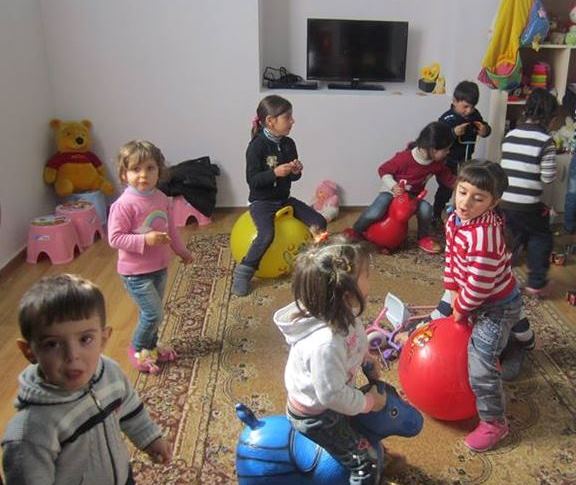
A kindergarten was opened on February 17th in Boslebi Village, Dmanisi municipality as a result of facilitation by the Dmanisi Women’s Room. The Kindergarten will serve 30 children not only Georgians from Boslebi Village but also from neighbor Kakliani Village which is mainly inhabited by Azeris. Four local women will be employed there.
In summer 2014 the Dmanisi Women’s Room was invited by Care International to apply to them to fund the construction of kindergarten under the framework of announced grant competition. Together with Care the opening of Kindergarten has been supported by the local government of Dmanisi municipality, which provided the funds for purchasing all necessary facilities for the kindergarten.
The Women’s Rooms representatives regularly arrange meeting in the villages of Kvemo Kartli to study the needs of local women and the issues they are facing in their everyday life. They take notes and not only try to convey the women’s voices to the local government but also to search for opportunities to improve the livelihood of the rural population. Kindergartens are the need most often expressed by rural women allowing them time for engaging in other activities and for the education of their children. The Women’s Rooms representatives try to facilitate making this service available for more women in the region and give chance to their children to get pre-school education.
For scaling up DRR facilitation of Local Self Governments by the programme the meeting was held with the Governor of Kvemo Kartli - Ramin Ismailov.
From the ISET Economist news (http://www.iset.ge/news/?p=3871)
By Eric Livny
Democracy and Freedom Watch reported October 9, that “Georgia’s controversial new immigration law may be changed”. The law, writes DFW, “has caused a wave of confusion and irritation in the country’s expat community. Prime Minister Irakli Gharibashvili … told journalists that if any defects become apparent after the enactment of the new law, ‘we’ll surely correct it.''
By Helen Bradbury: Team Leader, Alliances Lesser Caucasus Programme


Information matters, it is our currency, the substance, the commodity which keeps our programmes running. We live in an age of information, are afloat on and sometimes drowning in a sea of it. We may check the oracle of google in answer to any question, live feeds, notifications and a torrent of minutiae in a mélange of events of great importance, continually assail us. Once there were spin doctors, now most of us spin daily be it personally or professionally. We are aware of the need to manage information, to have enough of it and of the right kind and most of us are aware too of the need to understand its quality and to know when and what we have is enough or too little.
The villagers of Tsintskaro village have suffered for years from the twice yearly flow of more than 100,000 sheep, cattle, goats, donkeys, horses and shepherd dogs straight past their gates. The problem has been in impasse for years with no real ownership of the issue by the myriad actors involved. Now, the local government has spearheaded the movement to solve the problem calling together support from a group including the MOA, MOE, the Regional Government and Shepherds Association which has been working for three years to improve coordination and bring the matter of the Animal Movement Route to public attention.
Drought is one of the critical disaster issues being typical for Kvemo Kartli and significantly harming agricultural sector in the region. Severe drought that occurred in this area in July-August, 2014 has negatively affected livestock husbandry which resulted with the reduced milk yield, hay production and deteriorated pastures in Kvemo Kartli.
From the ISET Economist news (http://www.iset.ge/news/?s=survival&lang=en)
By Nino Mosiashvili
The conclusion of the Association Agreement (AA) with the European Union was euphorically acclaimed by Georgian media as well as political and economic decision makers. Part of the AA is the Deep and Comprehensive Free Trade Agreement (DCFTA). The DCFTA is intended to liberalize trade between Georgia and the EU by lowering tariffs and reducing non-tariff barriers. For agriculture, the most relevant changes relate to food safety (bacterial contaminants, pesticides, inspection, and labeling) as well as animal and plant health (phytosanitation). For the manufacturing sector, the removal of so-called “technical barriers to trade” is similarly important, with the goal being to prevent the usage of technical standards as a means to protect domestic markets from foreign competition. “If regulations are set arbitrarily, they could be used as an excuse for protectionism”, states the World Trade Organization on its homepage.