



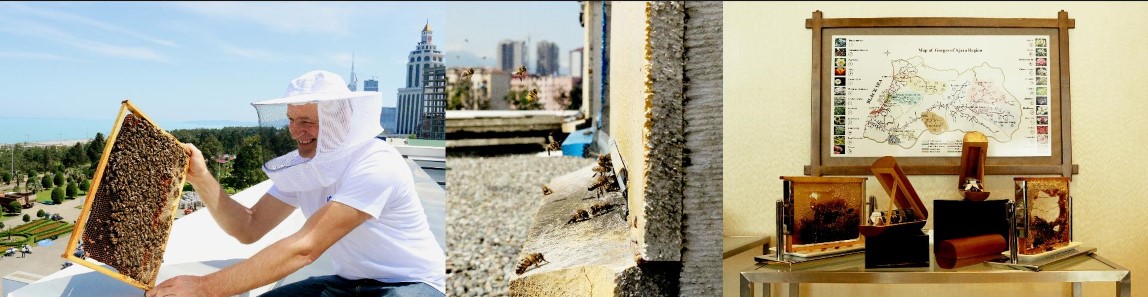
4 Beehives and their inhabitants from the high mountains of Ajara started their new life on the terrace of one of the largest Hotels in Batumi, Georgia, the Hilton Batumi, to produce honey for hotel guests. The General Manager of the Hilton, a keen birdwatcher and conservationist had the idea, seeking to showcase the beautiful countryside of Ajara and take this first step in illustrating the story of locally sourced food and the people who produce it.
By linking the hotel with the Ajara Beekeepers Business Association, the hives were installed. Urban beekeeping is increasingly popular in Europe as bee colonies decline and new ways are sought to develop a more ecologically sensitive lifestyle as urban centers grow. The Hilton also installed a honey showpiece at the breakfast buffet, of mounted honey comb, a large map of the 10 honey production gorges of mountainous Ajara and the indigenous flora on which the bees feed with the honey and comb sourced through honey producing company Matchakhela Ltd.
These initiatives which form a part of the ALCP programme’s work in the honey market system illustrate the great potential of the honey sector to feed into the promotion of Ajara as a great and varied tourist destination.
Income received from the Hotel hives will be donated to children in need in the rural municipalities.
News travels fast and perhaps other hotels may take up the initiative now it's been advertised through the Hilton chains newsletter.
Armenians have been living in Kvemo Kartli for centuries. According to the 2002 census 31,777 out of 497,530 Kvemo Kartli residents were Armenians. The number of Armenians is highest in Tsalka where 11,484 Armenians live, out of a total population of 20977. The advent of Armenians in Georgia was related to the movement of people during the Arab, Turk-Seljuk, Mongolian, Turkmen, Kizilbash, Ottoman Turk and other invasions. Several major settlements of Armenians took place in 1828-1829, during the Russian-Turkish war
Azerbaijanis living in Kvemo Kartli are Turkic-speaking people representing the legacy of the conquerors that came to this area at different times. in the 1926 Census they were referred to as Azerbaijanis. The Azeri population that settled in Kartli is comprised of two streams of migrants: 1. The Turkish-speaking population that was resettled between 15th-18th centuries; they went through the heaviest psychological and physical stress before they adapted to the new place. 2. Migrants who moved from one place to another to improve living conditions having adapted to the new environment. Currently the Azeri population in Georgia numbers 224,606. They mainly reside in Bolnisi, Dmanisi, Gardabani and Marneuli districts, mostly in district centers apart from in Dmanisi muniiciaplity where there are many Azeri villages. Some live in Tetritskaro and Tsalka districts.
In 1980’s the planned settlement of a large groups of eco-migrant Ajarians and Svanetians started in Tetritskaro and Tsalka municipalities. There were several streams of eco-migration up to 2003. The advent of these incomers has left its mark on Kvemo Kartli. It became richer from an ethnic, religious and language standpoint, however it also gave rise to new problems and challenges for new and old residents alike in seeking to adapt to the new cultural diversity.
The first settlement of Svans into Kvemo Kartli took place in 1987. This is when the Svans from landslide-affected Chviberi (higher Svaneti) were resettled in Dmanisi, in the houses built under a government programme. Svans started to introduce their style of life in Kvemo Kartli and establish strong communities in Kvemo Kartli.
In 2011 Alliances KK facilitated establishment of DRR Municipal Working Groups in Dmanisi, Tsalka and Tetritskaro municipalities. These groups remain to be the main point for planning and implementing of prevention measures to reduce livestock related disaster risks.



