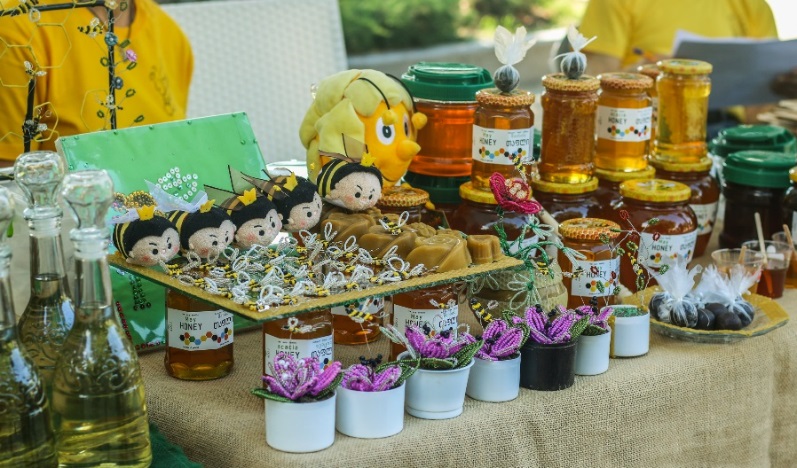
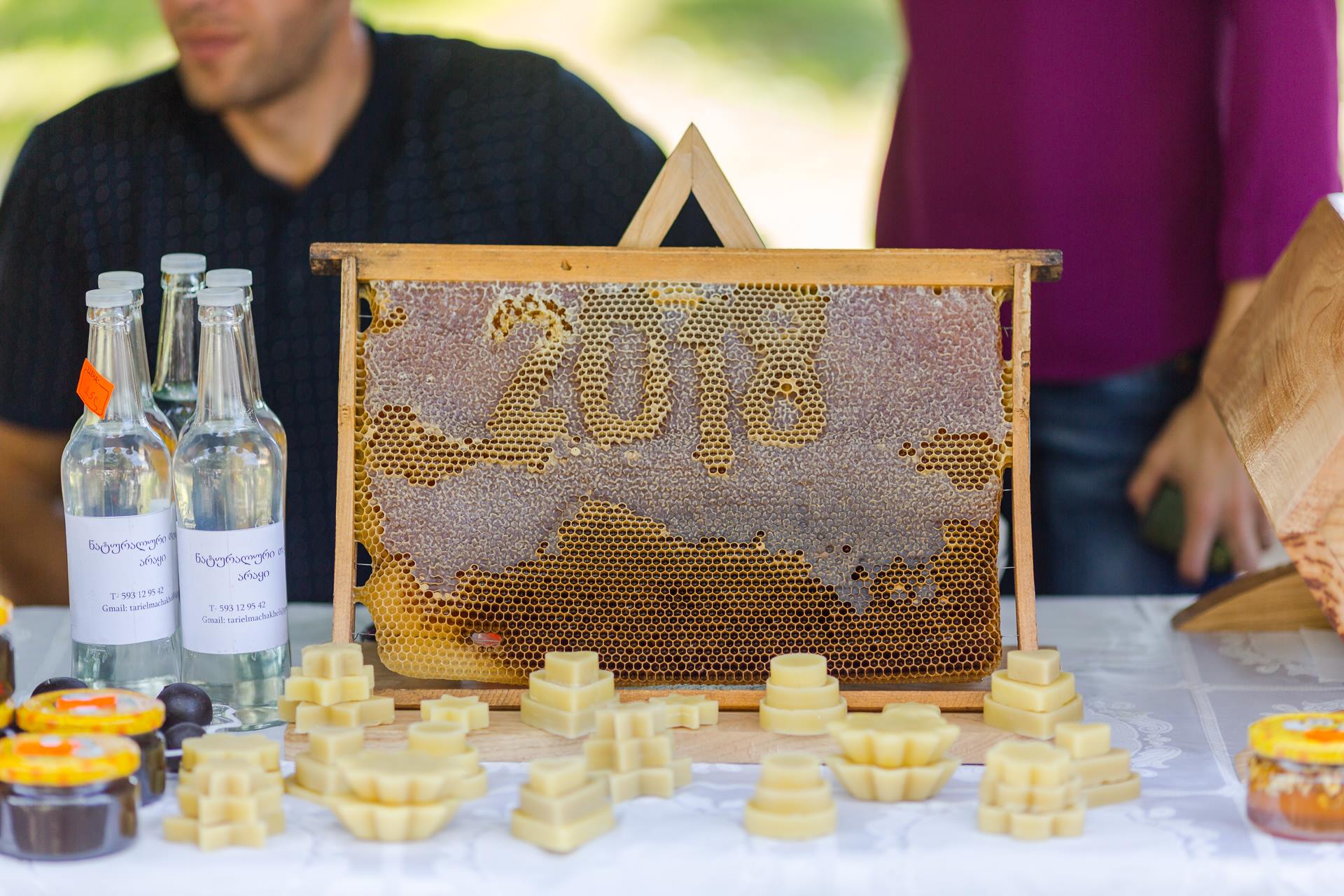
The annual Honey Festival was opened for the fourth time on August 11th on Batumi Boulevard and closed on August 12th in Batumi Botanical Garden. Up to 45 beekeepers from across Georgia once again presented their honey and by products for the festival visitors. Honey themed activities were held for children’s entertainment; visitors could see the ancient beehive at the special corner for jara beekeepers from Ajara and could taste different kind of honey from different parts of Georgia. Batumi Botanical Garden promoted Goderdzi Alpine Garden; live music kept the celebration spirit all day.
“Beekeeping is our family business. We started participating in the festival from the very beginning and it became a tradition. Each year we promote our products and each year we find new clients. This annual festival helps us to make our products more visible and popular” - Shorena Kezheradze, Khelvachauri municipality, Ajara.
“I have attended the festival in Batumi for the 1st time and the most important thing was linkages made at the festival. I’ve seen many new things, for example, Jara beehive and original packages for honey jars. These things made me think of new ideas how to advertise my product” - Tatyana Bulya, Zugdidi municipality, Samegrelo.
This year full sustainability was attained when the Ministry of Agriculture of Ajara officially allocated a budget for the festival with its N(N)LE Agroservice Center as the co-organizer of the festival along with the Ajara Beekeepers Business Association (ABBA) under the Ajara Chamber of Commerce and Industry (ACCI) as the main organizer.
“The festival is very important for promoting farmers and their products. The Ajara government supports such events to facilitate farmers and local honey producers to expend their businesses, make linkages and exchange experience among one another” – Tornike Rizhvadze, Chairman of the Government of Ajara.
“As we see, this year the festival is larger in scale and more organized in terms of labeling the product. Packaged, labeled and certified product is a step forward to the European and international market”. – Tite Aroshidze, Minister of Agriculture of Ajara.
Follow the Link of Adjara TV news on the event.
For scaling up DRR facilitation of Local Self Governments by the programme the meeting was held with the Governor of Kvemo Kartli - Ramin Ismailov.
From the ISET Economist news (http://www.iset.ge/news/?p=3871)
By Eric Livny
Democracy and Freedom Watch reported October 9, that “Georgia’s controversial new immigration law may be changed”. The law, writes DFW, “has caused a wave of confusion and irritation in the country’s expat community. Prime Minister Irakli Gharibashvili … told journalists that if any defects become apparent after the enactment of the new law, ‘we’ll surely correct it.''
By Helen Bradbury: Team Leader, Alliances Lesser Caucasus Programme


Information matters, it is our currency, the substance, the commodity which keeps our programmes running. We live in an age of information, are afloat on and sometimes drowning in a sea of it. We may check the oracle of google in answer to any question, live feeds, notifications and a torrent of minutiae in a mélange of events of great importance, continually assail us. Once there were spin doctors, now most of us spin daily be it personally or professionally. We are aware of the need to manage information, to have enough of it and of the right kind and most of us are aware too of the need to understand its quality and to know when and what we have is enough or too little.
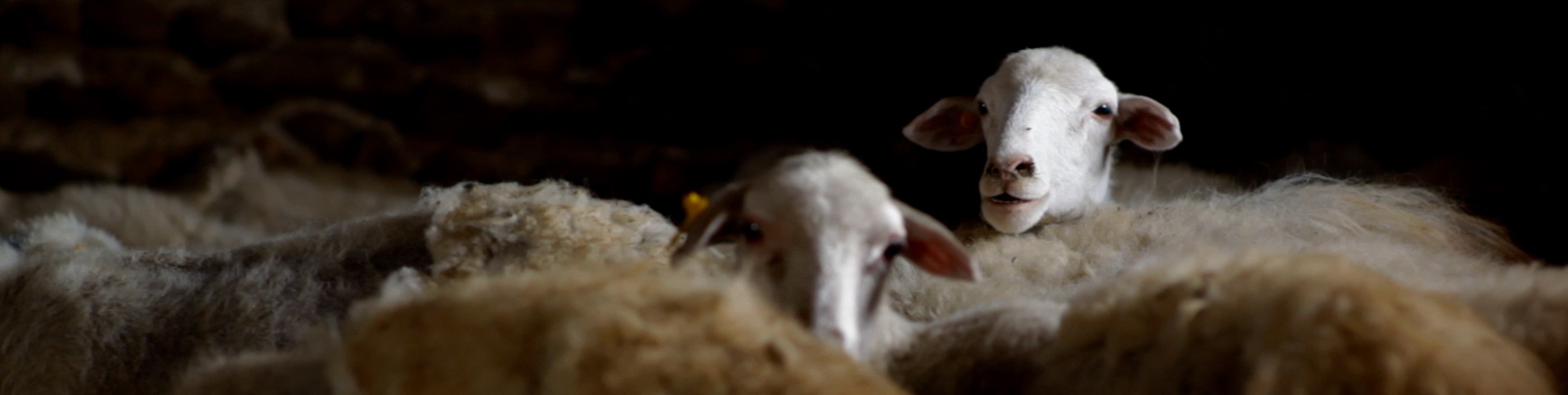
The villagers of Tsintskaro village have suffered for years from the twice yearly flow of more than 100,000 sheep, cattle, goats, donkeys, horses and shepherd dogs straight past their gates. The problem has been in impasse for years with no real ownership of the issue by the myriad actors involved. Now, the local government has spearheaded the movement to solve the problem calling together support from a group including the MOA, MOE, the Regional Government and Shepherds Association which has been working for three years to improve coordination and bring the matter of the Animal Movement Route to public attention.
Drought is one of the critical disaster issues being typical for Kvemo Kartli and significantly harming agricultural sector in the region. Severe drought that occurred in this area in July-August, 2014 has negatively affected livestock husbandry which resulted with the reduced milk yield, hay production and deteriorated pastures in Kvemo Kartli.
From the ISET Economist news (http://www.iset.ge/news/?s=survival&lang=en)
By Nino Mosiashvili
The conclusion of the Association Agreement (AA) with the European Union was euphorically acclaimed by Georgian media as well as political and economic decision makers. Part of the AA is the Deep and Comprehensive Free Trade Agreement (DCFTA). The DCFTA is intended to liberalize trade between Georgia and the EU by lowering tariffs and reducing non-tariff barriers. For agriculture, the most relevant changes relate to food safety (bacterial contaminants, pesticides, inspection, and labeling) as well as animal and plant health (phytosanitation). For the manufacturing sector, the removal of so-called “technical barriers to trade” is similarly important, with the goal being to prevent the usage of technical standards as a means to protect domestic markets from foreign competition. “If regulations are set arbitrarily, they could be used as an excuse for protectionism”, states the World Trade Organization on its homepage.