



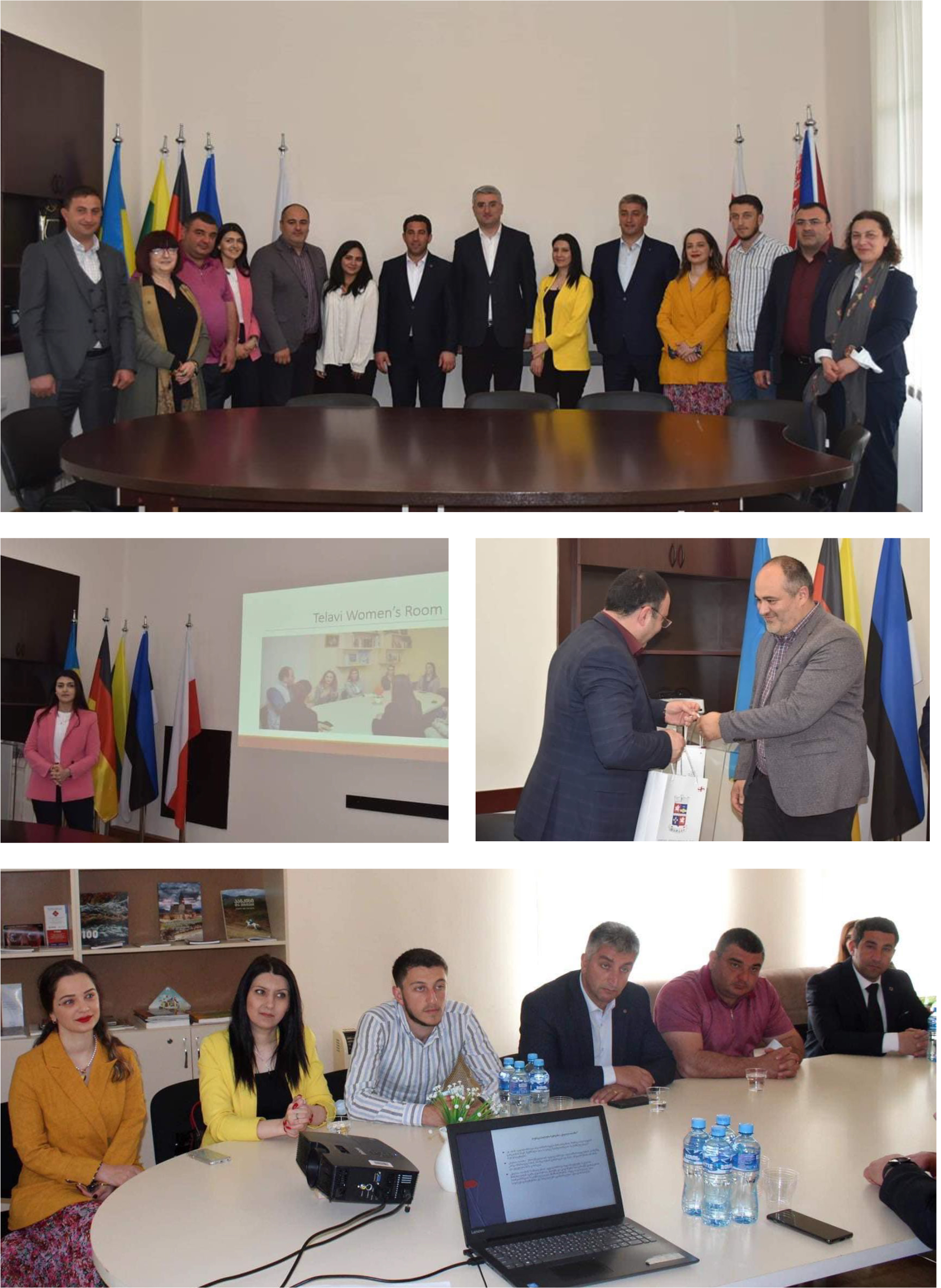
For three days from 11-14 April, the Women’s Rooms Union of Georgia NGO hosted an Armenian delegation of the Mayors of Alaverdi, Tumanyan and Tashir municipalities of Armenia, their three Women’s Rooms managers, representatives of Lori Region Governor’s office and the Association of Lawyers Community NGO. These three municipalities in Armenia have now all instituted Women’s Rooms and were in Georgia to learn more about their operation and potential and to strengthen links in the region.
They met the mayors and deputy mayors of Akhmeta and Telavi municipalities, and a representative of Kakheti Governor’s office and visited the rooms. The Women’s Room managers of both municipalities did presentations on their work.
‘It was a very interesting and useful visit. We have just established the Women’s Room service in our municipality and, as we’ve copied the Georgian model, it was necessary for us to see how this it works here,’ – Suren Tumanyan, the mayor of Tumanyan municipality said.
‘After this visit we clearly see how to use our Women’s Rooms and make sure that our women and girls are involved in local decision making through the Women’s Room as it was done in Georgia,’ – Edgar Arshakyan, the mayor of Tashir municipality said.
One of the main goals of the municipal Women’s Rooms in Georgia is to support women’s entrepreneurship by helping them write business proposals, connect with other women entrepreneurs and access the trainings and information. Participants visited social enterprise Skhivi, where women are making traditional enamel jewelry and accessories, the shop of entrepreneur Tamar Mikeladze, who is making handmade soaps and candles under the brand name Kumpa, and a local female beekeeper.
‘We are impressed with the results of Georgian Women’s Rooms regarding women’s economic empowerment. The managers here had business plan writing and fundraising trainings to help local women to start their own businesses. We are looking forward to doing the same in Armenia,’ – Sasun Khechumyan, the mayor of Alaverdi said.
‘In Lori region there are five municipalities in total, out of which three municipalities have already opened the Women’s Rooms. We are ready to support the opening of this service in the other two municipalities as well,’ – Alik Sahakyan, the representative of Lori Governor’s office said.
This study tour has laid the foundation for future cooperation between Georgian and Armenian municipalities. Alaverdi and Akhmeta municipalities have decided to become twin towns and the Women’s Rooms Union is going to continue cooperation with these Armenia municipalities.
Background information: From 2011 to date the SDC and ADA funded Mercy Corps implemented Alliances Caucasus Programme has been facilitating the establishment and scaling up the municipal Women’s Rooms in Georgia and Armenia. 32 Women’s Rooms in Georgia and three Women’s Rooms in Armenia have been opened so far. The Women’s Rooms are owned by local governments and are used to facilitate access to public decision making, goods and economic opportunities. The Women’s Rooms Union was formed in 2021 to represent the rooms and facilitate their interests.
The information about the visit was posted on a Facebook pages of Telavi and Akhmeta City Halls.
Local TV Tanamgzavri made two news items about the visit. Please, follow the links below:
Meeting at Telavi City Hall * Visiting Local Women Entrepreneurs
Follow the link to watch The Women’s Rooms Promo Video
Heather Briggs, agronomist, agro-consultant on plant productivity, international expert on cheese and journalist visited Tbilisi to hold the training for agro-journalists last week. "Batumelebi" newspaper interviewed her.
For the first time in Georgia a training on agro journalism was conducted for media representatives wishing to report specifically on rural issues and news. The main purpose of the training was to fill knowledge gaps of media practitioners in crops, livestock husbandry and agriculture management and to introduce the basics of agro journalism. Heather Briggs, an international expert and member of British Guild of Agricultural Journalists - was invited to lead a 5 day training from January 26th to February 2nd. About 50 representatives of regional, national broadcasters and printed media participated in the event. The training was organized by the Georgian Regional Media Association and facilitated by the Alliances Lesser Caucasus Programme.
By Helen Bradbury: Team Leader, Alliances Lesser Caucasus Programme
We are in an interesting conundrum. Gender in most places has been written-in to law. Bar a few notable exceptions, every country in the world, has varying degrees of success in applying universal suffrage. Fifty countries are signed up to the CEDAW convention (the UN’s Convention on the Elimination of all forms of Discrimination Against Women). On the CEDAW world map of Discrepant Government Behaviour Concerning Women, the countries shaded dark green which denotes ‘virtually no enforcement of laws consonant with CEDAW or such laws do not even exist’, are where you expect them to be and in fact they are relatively few. It is the next two categories which disturb, covering the vast majority of the globe, the mid and lighter green, where laws are partly or fully consonant with CEDAW but there is little effective enforcement or spotty enforcement of them and the issue is low priority or hit and miss. After the gains, the laws and ratifications of the last centuries it seems that we must tread very carefully indeed for we must counteract indifference, in which inertia and inactivity stop us moving forward.
Government Momentum Builds on Animal Movement Route after the years of discussion and information exchange. The biggest challenge in Georgian sheep sector – the Animal Movement Route issue has come to the point when there is a willingness and concrete plan for taking actions and reaching tangible results.
The Eco Films LTD film The Road, commissioned by ALCP KK, was shown at the BIFED - Bozcaada International Festival of Ecological Documentary on October 31, 2014. The documentary was presented in the non-competition section and highly appreciated by the audience.
In October 24th the first flocks of migrating animals went through the newly arranged bypass route in Tsintskaro village, Tetritskaro Municipality. Testing of the new route was carried out successfully - sheep, cattle, horses, donkeys, dogs and shepherds passed on the new road without any difficulties. The movement was monitored by the Tetritskaro Municipality DRR WG members and the Tsintskaro village Rep.



