



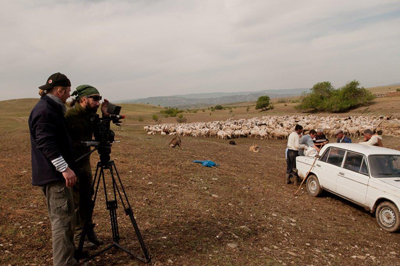
Mercy Corps, Alliances KK has contracted “Eco Films” a Georgian independent wildlife film company to create a documentary about shepherds of Kvemo Kartli region. In the film “Two Week to Reach the Clouds” the process of animal movement from winter pastures in Kakheti to summer pastures in Kvemo Kartli will be depicted following a herder family during two-week-long trip from the lowlands to the highlands. The aim of the documentary is to show the cultural-traditional context of Georgian sheep farming based on the example of one sheep farmer family and its herd. The film will also show social as well as economic importance of the sheep migration and associated problems within the context of Georgia’s diversified nature and landscape.
Shooting started in May 11th after preparing the plotline and choosing the sheep farmers who will be the main characters in the documentary. The final version of it will be available by the end of the year (2013).
Sheep farming is the oldest branch of Georgia’s agriculture. According to official statistics there are almost 600 thousand sheep in the country. Georgian herdsmen lead a nomadic life covering hundreds of kilometers with their herd when moving from winter pastures of Kakheti and Kvemo Kartli to summer pastures of Samtskhe-Javakheti, Kvemo Kartli, Mtskheta-Mtianeti and Kakheti highlands. The herdsmen spend approximately two weeks with their herds in moving alone the routes.
The current year appears to be a fruitful for sheep-farming, the Feasibility Study of Animal Movement Route funded by the MOA is under development. Wool collection with export in Turkey has commenced in Kvemo Kartli and Kakheti. Work is ongoing to develop the Shepherd Association.
In October 24th the first flocks of migrating animals went through the newly arranged bypass route in Tsintskaro village, Tetritskaro Municipality. Testing of the new route was carried out successfully - sheep, cattle, horses, donkeys, dogs and shepherds passed on the new road without any difficulties. The movement was monitored by the Tetritskaro Municipality DRR WG members and the Tsintskaro village Rep.
For scaling up DRR facilitation of Local Self Governments by the programme the meeting was held with the Governor of Kvemo Kartli - Ramin Ismailov.
From the ISET Economist news (http://www.iset.ge/news/?p=3871)
By Eric Livny
Democracy and Freedom Watch reported October 9, that “Georgia’s controversial new immigration law may be changed”. The law, writes DFW, “has caused a wave of confusion and irritation in the country’s expat community. Prime Minister Irakli Gharibashvili … told journalists that if any defects become apparent after the enactment of the new law, ‘we’ll surely correct it.''
By Helen Bradbury: Team Leader, Alliances Lesser Caucasus Programme


Information matters, it is our currency, the substance, the commodity which keeps our programmes running. We live in an age of information, are afloat on and sometimes drowning in a sea of it. We may check the oracle of google in answer to any question, live feeds, notifications and a torrent of minutiae in a mélange of events of great importance, continually assail us. Once there were spin doctors, now most of us spin daily be it personally or professionally. We are aware of the need to manage information, to have enough of it and of the right kind and most of us are aware too of the need to understand its quality and to know when and what we have is enough or too little.
The villagers of Tsintskaro village have suffered for years from the twice yearly flow of more than 100,000 sheep, cattle, goats, donkeys, horses and shepherd dogs straight past their gates. The problem has been in impasse for years with no real ownership of the issue by the myriad actors involved. Now, the local government has spearheaded the movement to solve the problem calling together support from a group including the MOA, MOE, the Regional Government and Shepherds Association which has been working for three years to improve coordination and bring the matter of the Animal Movement Route to public attention.
Drought is one of the critical disaster issues being typical for Kvemo Kartli and significantly harming agricultural sector in the region. Severe drought that occurred in this area in July-August, 2014 has negatively affected livestock husbandry which resulted with the reduced milk yield, hay production and deteriorated pastures in Kvemo Kartli.



