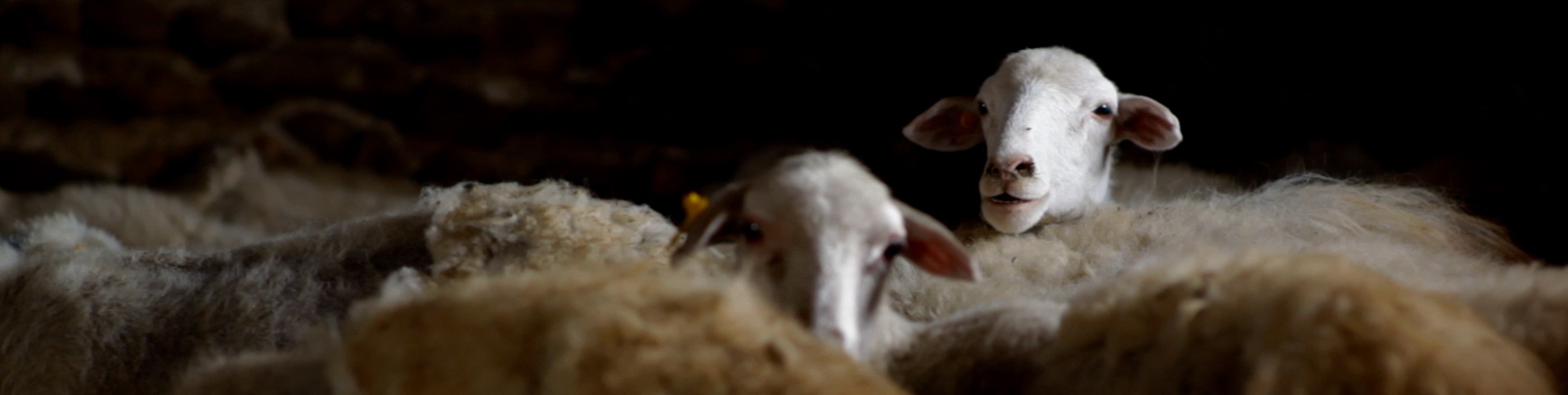
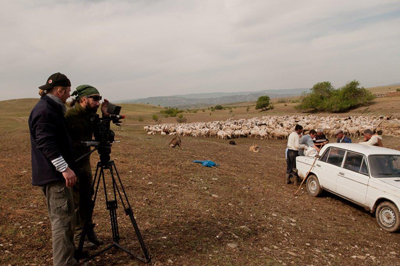
Mercy Corps, Alliances KK has contracted “Eco Films” a Georgian independent wildlife film company to create a documentary about shepherds of Kvemo Kartli region. In the film “Two Week to Reach the Clouds” the process of animal movement from winter pastures in Kakheti to summer pastures in Kvemo Kartli will be depicted following a herder family during two-week-long trip from the lowlands to the highlands. The aim of the documentary is to show the cultural-traditional context of Georgian sheep farming based on the example of one sheep farmer family and its herd. The film will also show social as well as economic importance of the sheep migration and associated problems within the context of Georgia’s diversified nature and landscape.
Shooting started in May 11th after preparing the plotline and choosing the sheep farmers who will be the main characters in the documentary. The final version of it will be available by the end of the year (2013).
Sheep farming is the oldest branch of Georgia’s agriculture. According to official statistics there are almost 600 thousand sheep in the country. Georgian herdsmen lead a nomadic life covering hundreds of kilometers with their herd when moving from winter pastures of Kakheti and Kvemo Kartli to summer pastures of Samtskhe-Javakheti, Kvemo Kartli, Mtskheta-Mtianeti and Kakheti highlands. The herdsmen spend approximately two weeks with their herds in moving alone the routes.
The current year appears to be a fruitful for sheep-farming, the Feasibility Study of Animal Movement Route funded by the MOA is under development. Wool collection with export in Turkey has commenced in Kvemo Kartli and Kakheti. Work is ongoing to develop the Shepherd Association.
From the ISET Economist news (http://www.iset.ge/news/?s=survival&lang=en)
By Nino Mosiashvili
The conclusion of the Association Agreement (AA) with the European Union was euphorically acclaimed by Georgian media as well as political and economic decision makers. Part of the AA is the Deep and Comprehensive Free Trade Agreement (DCFTA). The DCFTA is intended to liberalize trade between Georgia and the EU by lowering tariffs and reducing non-tariff barriers. For agriculture, the most relevant changes relate to food safety (bacterial contaminants, pesticides, inspection, and labeling) as well as animal and plant health (phytosanitation). For the manufacturing sector, the removal of so-called “technical barriers to trade” is similarly important, with the goal being to prevent the usage of technical standards as a means to protect domestic markets from foreign competition. “If regulations are set arbitrarily, they could be used as an excuse for protectionism”, states the World Trade Organization on its homepage.
Livestock transhumance will no longer disturb Tsintskaro Village population in Tetritskaro Municipality. The local Municipal DRR Working Group initiated a new infrastructure project which will solve the problems related to the seasonal transhumance in this particular village.
From the ISET Economist news (http://www.iset.ge/news/?p=3311)
By Eric Livny
(Summary of a debate hosted by ISET as part of SDC-supported Inclusive Growth Dialog series.)
There are many reasons to love the concept of farmer cooperation (and cooperation more generally). To begin with, there is a great aesthetic value in seeing people coming together, sharing resources and helping each other. After all, instinctive collectivism was the basic condition of human existence from time immemorial. But, there are also powerful economic reasons for farmer cooperation.
The Road – a beautifully shot documentary capturing the reality and dichotomies of the people who use the ancient transhumance route; the lifeline of livestock in Georgia
A Memorandum of Understanding has been signed between the Ministry of Regional Development and Infrastructure (MRDI) and the Swiss Development Cooperation project the Mercy Corps Georgia implemented, Alliances Lesser Caucasus Programme (ALCP) in Kvemo Kartli, The aim of the memorandum is to support the ongoing outreach at local government level of practical implementation of the 2010 Georgian Gender Equality Law which will greatly aid in the general development of rural Georgian municipalities.
From the ISET Economist news (http://www.iset.ge/news/?p=3056)
By Tim Stewart
As Georgia embarks on an ambitious program to develop farmer organizations, it is worth considering both the positive and negative lessons from the experience of similar initiatives, both in Georgia and elsewhere in the developing/transition context. The piece by Tim Stewart, originally published on www.springfieldcentre.com, identifies some of the main reasons for the failure of start-up farmer organizations. The challenge for Georgia is to learn from these mistakes in planning and implementation, and ensure improved coordination among the many cooks involved (the newly created Agency for the Development of Agricultural Cooperatives, the Ministry of Agriculture, international donors, NGOs, and farmer associations).