



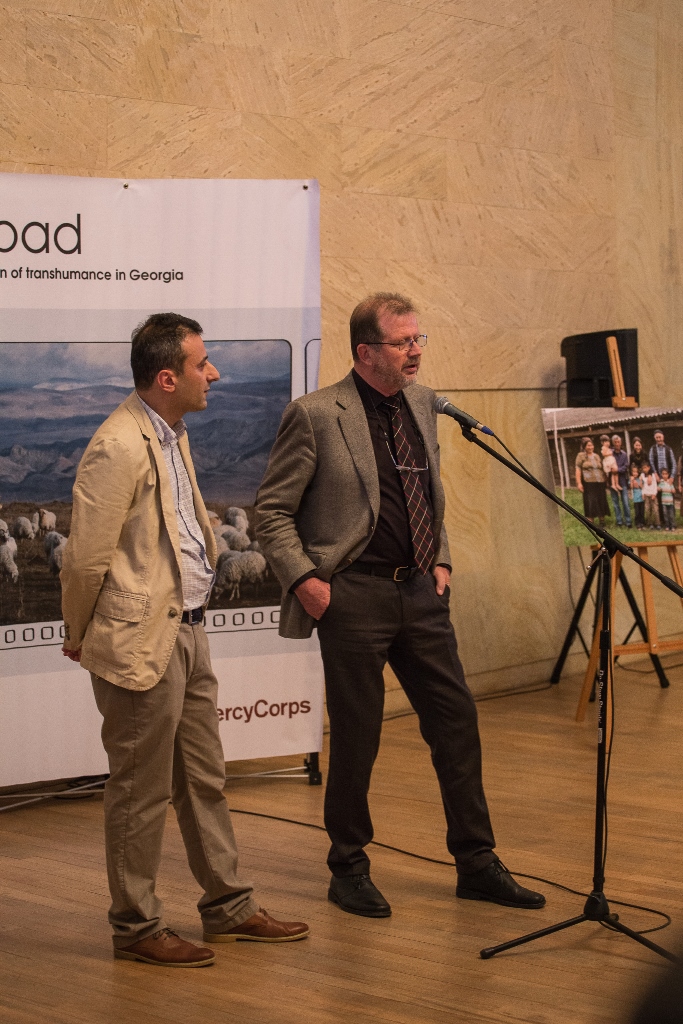
The Road – a beautifully shot documentary capturing the reality and dichotomies of the people who use the ancient transhumance route; the lifeline of livestock in Georgia
The Eco Films LTD film The Road premiered on April 4, 2014 in the assembly hall of Tbilisi State University. The film commissioned by Alliances Kvemo Kartli - a Swiss Development and Cooperation Agency project implemented by Mercy Corps Georgia - depicts the transhumance route from the Kakheti winter pastures to Samtskhe-Javakheti summer highland pastures through Kvemo Kartli region. The documentary shows the traditional cultural context of Georgian sheep farming following one sheep farmer, shepherds and herds along the route it shows the socio-economic importance of this seasonal movement of sheep and its realities and problems within the context of modern Georgia whilst showcasing the diversified nature and beautiful landscape of Georgia.
Creating a film on shepherds’ lives in Georgia is timely as development of agriculture was declared to be the priority of the Georgian Government this year. The film contains important messages for people who are interested to support the growth of sheep farming in Georgia.
“The Georgian regional and central governments are actively involved in regulation of Animal Movement Route’s infrastructure. This film will serve to enhance interest on this issue and I hope the tough life of shepherds, which is shown in the film, will be improved very soon,” – stated the Governor of Kvemo Kartli Region George Mgebrishvili after the premiere.
Almost 200 people attended ‘The Road’ premiere which triggered great interest among people from various fields: film industry, agriculture development, government, educational field and etc.
“The film is very realistic and truthful. I had the feeling that I was there too. It shows all the problems and at the same time is beautiful. We would like to show this film to our students and are also ready to finance our 4th grade students’ study practice in nomadic sheep farming this summer,” – said Teo Urushadze, the Dean of the Faculty of Agricultural and Natural Sciences of Georgian Agrarian University.
The new documentary was highly appreciated by the audience and Eco Films intend to promote their film, on National and International levels. The screening of The Road is already planned in the Georgian Parliament in Kutaisi initiated and supported by the Head of the Agrarian Committee Mr. Gigla Agulashvili.
Armenians have been living in Kvemo Kartli for centuries. According to the 2002 census 31,777 out of 497,530 Kvemo Kartli residents were Armenians. The number of Armenians is highest in Tsalka where 11,484 Armenians live, out of a total population of 20977. The advent of Armenians in Georgia was related to the movement of people during the Arab, Turk-Seljuk, Mongolian, Turkmen, Kizilbash, Ottoman Turk and other invasions. Several major settlements of Armenians took place in 1828-1829, during the Russian-Turkish war
Azerbaijanis living in Kvemo Kartli are Turkic-speaking people representing the legacy of the conquerors that came to this area at different times. in the 1926 Census they were referred to as Azerbaijanis. The Azeri population that settled in Kartli is comprised of two streams of migrants: 1. The Turkish-speaking population that was resettled between 15th-18th centuries; they went through the heaviest psychological and physical stress before they adapted to the new place. 2. Migrants who moved from one place to another to improve living conditions having adapted to the new environment. Currently the Azeri population in Georgia numbers 224,606. They mainly reside in Bolnisi, Dmanisi, Gardabani and Marneuli districts, mostly in district centers apart from in Dmanisi muniiciaplity where there are many Azeri villages. Some live in Tetritskaro and Tsalka districts.
In 1980’s the planned settlement of a large groups of eco-migrant Ajarians and Svanetians started in Tetritskaro and Tsalka municipalities. There were several streams of eco-migration up to 2003. The advent of these incomers has left its mark on Kvemo Kartli. It became richer from an ethnic, religious and language standpoint, however it also gave rise to new problems and challenges for new and old residents alike in seeking to adapt to the new cultural diversity.
The first settlement of Svans into Kvemo Kartli took place in 1987. This is when the Svans from landslide-affected Chviberi (higher Svaneti) were resettled in Dmanisi, in the houses built under a government programme. Svans started to introduce their style of life in Kvemo Kartli and establish strong communities in Kvemo Kartli.
In 2011 Alliances KK facilitated establishment of DRR Municipal Working Groups in Dmanisi, Tsalka and Tetritskaro municipalities. These groups remain to be the main point for planning and implementing of prevention measures to reduce livestock related disaster risks.



