



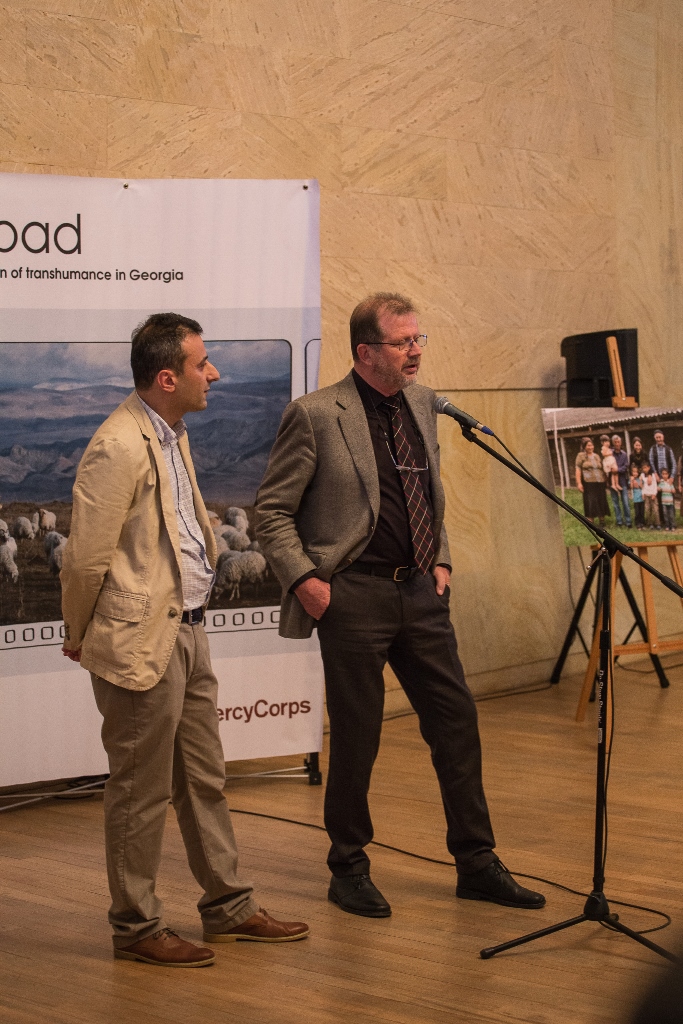
The Road – a beautifully shot documentary capturing the reality and dichotomies of the people who use the ancient transhumance route; the lifeline of livestock in Georgia
The Eco Films LTD film The Road premiered on April 4, 2014 in the assembly hall of Tbilisi State University. The film commissioned by Alliances Kvemo Kartli - a Swiss Development and Cooperation Agency project implemented by Mercy Corps Georgia - depicts the transhumance route from the Kakheti winter pastures to Samtskhe-Javakheti summer highland pastures through Kvemo Kartli region. The documentary shows the traditional cultural context of Georgian sheep farming following one sheep farmer, shepherds and herds along the route it shows the socio-economic importance of this seasonal movement of sheep and its realities and problems within the context of modern Georgia whilst showcasing the diversified nature and beautiful landscape of Georgia.
Creating a film on shepherds’ lives in Georgia is timely as development of agriculture was declared to be the priority of the Georgian Government this year. The film contains important messages for people who are interested to support the growth of sheep farming in Georgia.
“The Georgian regional and central governments are actively involved in regulation of Animal Movement Route’s infrastructure. This film will serve to enhance interest on this issue and I hope the tough life of shepherds, which is shown in the film, will be improved very soon,” – stated the Governor of Kvemo Kartli Region George Mgebrishvili after the premiere.
Almost 200 people attended ‘The Road’ premiere which triggered great interest among people from various fields: film industry, agriculture development, government, educational field and etc.
“The film is very realistic and truthful. I had the feeling that I was there too. It shows all the problems and at the same time is beautiful. We would like to show this film to our students and are also ready to finance our 4th grade students’ study practice in nomadic sheep farming this summer,” – said Teo Urushadze, the Dean of the Faculty of Agricultural and Natural Sciences of Georgian Agrarian University.
The new documentary was highly appreciated by the audience and Eco Films intend to promote their film, on National and International levels. The screening of The Road is already planned in the Georgian Parliament in Kutaisi initiated and supported by the Head of the Agrarian Committee Mr. Gigla Agulashvili.
From the ISET Economist news (http://www.iset.ge/news/?p=4633)
By Eric Livny
The “do no harm” (primum non nocere) principle is well known to students of medical schools. It is one of the most fundamental maxims in medicine, as formulated, for example, in the Epidemics book of the Hippocratic Collection:
“The physician must … have two special objects in view with regard to disease, namely, to do good or to do no harm“.
Doctors are taught that medical interventions are not risk-free. Thus, when facing a “problem” one should consider whether to use a particular procedure (e.g. surgery or chemical treatment) or do NOTHING.
Not surprisingly, this very principle has applications in many fields other than healthcare. And it is high time for this principle to be studied and applied in Georgian policymaking.
Heather Briggs, agronomist, agro-consultant on plant productivity, international expert on cheese and journalist visited Tbilisi to hold the training for agro-journalists last week. "Batumelebi" newspaper interviewed her.
For the first time in Georgia a training on agro journalism was conducted for media representatives wishing to report specifically on rural issues and news. The main purpose of the training was to fill knowledge gaps of media practitioners in crops, livestock husbandry and agriculture management and to introduce the basics of agro journalism. Heather Briggs, an international expert and member of British Guild of Agricultural Journalists - was invited to lead a 5 day training from January 26th to February 2nd. About 50 representatives of regional, national broadcasters and printed media participated in the event. The training was organized by the Georgian Regional Media Association and facilitated by the Alliances Lesser Caucasus Programme.
By Helen Bradbury: Team Leader, Alliances Lesser Caucasus Programme
We are in an interesting conundrum. Gender in most places has been written-in to law. Bar a few notable exceptions, every country in the world, has varying degrees of success in applying universal suffrage. Fifty countries are signed up to the CEDAW convention (the UN’s Convention on the Elimination of all forms of Discrimination Against Women). On the CEDAW world map of Discrepant Government Behaviour Concerning Women, the countries shaded dark green which denotes ‘virtually no enforcement of laws consonant with CEDAW or such laws do not even exist’, are where you expect them to be and in fact they are relatively few. It is the next two categories which disturb, covering the vast majority of the globe, the mid and lighter green, where laws are partly or fully consonant with CEDAW but there is little effective enforcement or spotty enforcement of them and the issue is low priority or hit and miss. After the gains, the laws and ratifications of the last centuries it seems that we must tread very carefully indeed for we must counteract indifference, in which inertia and inactivity stop us moving forward.
Government Momentum Builds on Animal Movement Route after the years of discussion and information exchange. The biggest challenge in Georgian sheep sector – the Animal Movement Route issue has come to the point when there is a willingness and concrete plan for taking actions and reaching tangible results.
The Eco Films LTD film The Road, commissioned by ALCP KK, was shown at the BIFED - Bozcaada International Festival of Ecological Documentary on October 31, 2014. The documentary was presented in the non-competition section and highly appreciated by the audience.



