



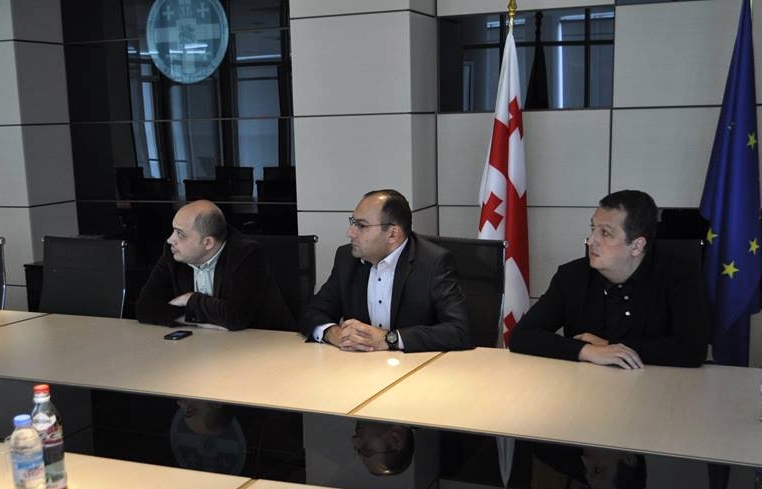
For scaling up DRR facilitation of Local Self Governments by the programme the meeting was held with the Governor of Kvemo Kartli - Ramin Ismailov. In 2012-2014 the programme facilitated creation of Municipal Working Groups on Animal Disease Control and Disaster Risk Reduction in Dmanisi, Tetritskaro and Tsalka municipalities as a mechanism for reducing livestock related disaster risks at municipal level. In the phase II the programme intends to scale up its facilitation regarding DRR by extending this model in three other municipalities of Kvemo Kartli. The purpose of the meeting was to engage the Governor’s office in this process by transforming it into a regional model.
“The Governor’s office now is responsible for imposing the veterinarian quarantines but we don’t have any mechanism to monitor how it is carried out by the local self-governments and the NFA. I think that we could adopt the proposed model and create an Animal disease Control and Disaster Risk Reduction Regional Board which will coordinate the Municipal DRR working groups,” – the Governor stated.
Also at the end of the meeting the Governor raised an issue regarding an increased incidence of rabies cases in Kvemo Kartli.
“Currently we have the problem in regard to frequent cases of rabies in Kvemo Kartli and we will be grateful, if you help us to overcome this problem by providing proper expertise of situation and recommendations,” – he said.
As a result of the meeting the sides agreed that they will continue cooperation by making concrete plan for setting up the Regional Model for disease & disaster notification, control and reporting, which will push in the process of preparation & planning and mitigation at local self-government’s level. Furthermore with facilitation of the programme the Governor’s office will contact the local self-governments in the region for ensuring that above mentioned working groups were established and work properly.
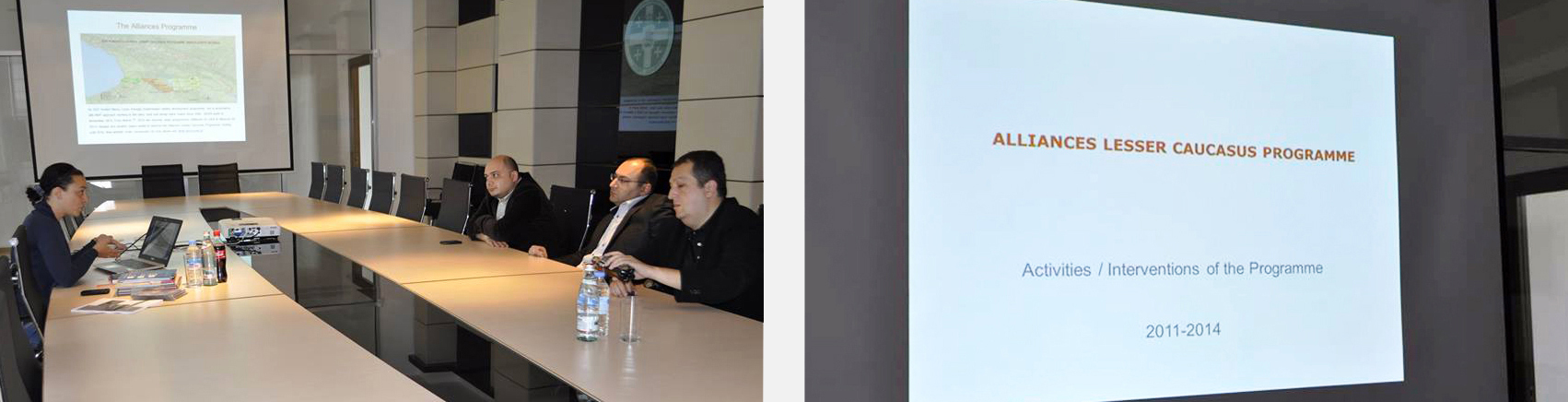
A new project “Closer to Nature” was launched by Batumi Botanical Garden facilitated by ALCP AJ to promote 165 school student’s involvement in biodiversity and environmental protection activities.
The Memorandum of Understanding was signed between the Minister of Agriculture, the National Food Agency and SDC funded, Mercy Corps Georgia implemented ALCP on March 31st 2015. Within the framework of this memorandum ALCP will facilitate the building of two Bio-security yards with water points on the Animal Movement Route in Kvemo Kartli region, another three Bio-security yards will be financed from the State Budget.
The advisors from 5 municipalities of Ajara were trained on how to increase women participation in community meetings. Following the training facilitated by ALCP AJ, they worked with the Village Representatives and as a result of their activities, the attendance of women in these meetings has increased by 10-15%.
Very soon the Kvemo Kartli Region will have a new regional mechanism for Disaster Risk Reduction implemented by Local municipalities and the Kvemo Kartli Governor’s office. The Governor of Kvemo Kartli Paata Khizanishvili discussed this topic with the Gamgebelies of the region, deputy governors, the Mayor of Rustavi City and representatives of Alliances Lesser Caucasus Programme (ALCP) on March 11, 2015. The importance of regional coordination and the necessity of creating working groups in all municipalities were highlighted during the meeting.
The Advisory Committee was established in Ajara, which is supposed to be a forum for regional players representing national, local and regional government, civil society and the private sector to tackle key issues in agriculture sector. The participants discussed the role of the Self-governments in Disaster Risk Reduction, wildlife related issues in the region and also clarified the functions of the newly formed Municipal DRR Working Group in five municipalities of Ajara.
A kindergarten was opened on February 17th in Boslebi Village, Dmanisi municipality as a result of facilitation by the Dmanisi Women’s Room. The Kindergarten will serve 30 children not only Georgians from Boslebi Village but also from neighbor Kakliani Village which is mainly inhabited by Azeris. Four local women will be employed there.



