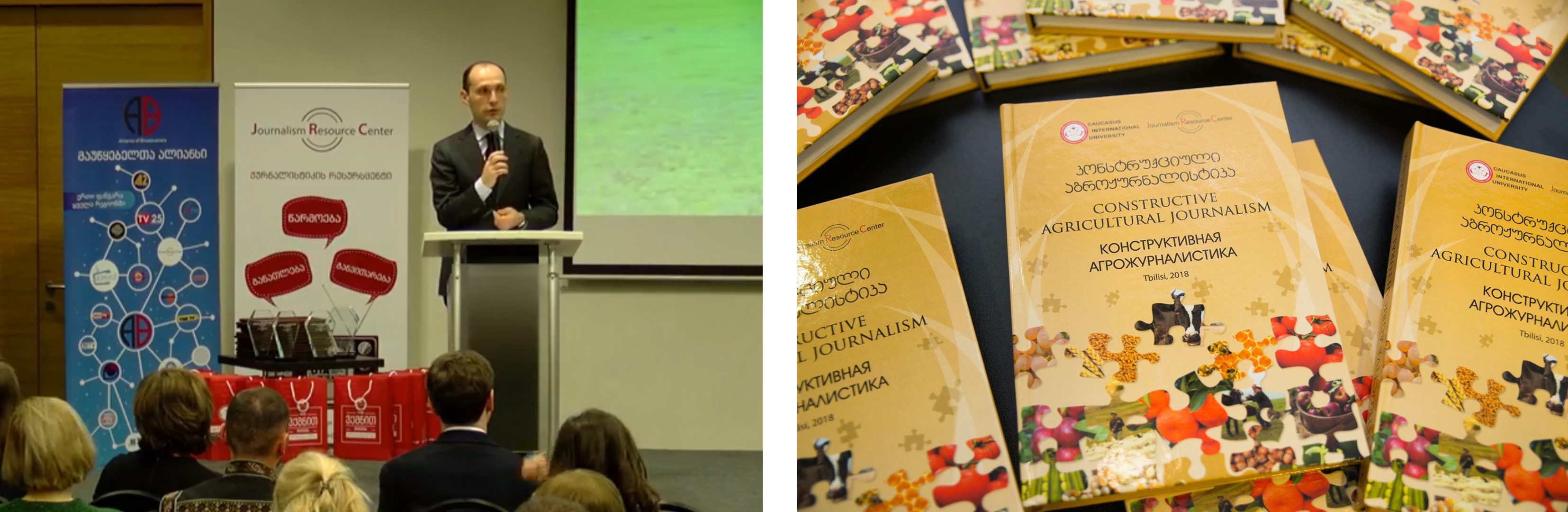
On December 26th, the Journalism Resource Centre presented its second edition of the agri journalism module. About hundred guests from the government, business and academic sphere attended the event.
The Minister of Environmental Protection and Agriculture of Georgia, Levan Davitashvili stated: ‘I am very glad to hear about all the initiatives related to agri journalism. Education is very important in agriculture for ensuring information dissemination for farmers. The door of the Minister of Agriculture is open for you at any time and our partnership with regional media is very important.’
The agri module was created for inclusion in BA in journalism degrees. Now, ten universities across Georgia have the agri journalism module established in their curriculum, lasting one semester with a total of 15 credit hours. Four more universities are about to do the same this year. 369 students have undergone the course in Georgia to date. Now those initiatives are ready for transfer to Armenia and Azerbaijan.
During the event, the Journalism Resource Centre awarded farmers and specialists within the agricultural sector. The Best Female Farmer of the Year award was given to beekeeper Mariam Kiladze; the Best Vet of the Year was Giorgi Tcikhelashvili from Dmanisi, he is 25 years-old who graduated from the Vet Department at Agrarian University and went back to Dmanisi and is working as a vet. The Best Male Farmer award was given to shepherd Giorgi Imerlishvili. Credo and the EBRD were recognized as financial institutions that supports agriculture, and SDC Project Mercy Corps Alliances Caucasus Programme for supporting agri media journalism.
At the end of the event, the Journalism Resource Centre announced the establishment of the Agro Guild, which unites journalists and media organizations, businesses, farmers, public officials, and universities and sets up annual or bi-annual advisory committees. The members of media associations and the JRC also announced that they are planning to establish an Agri TV program, the pilot of which will start in three months.
Follow this link for additional news regarding the event.
Locals, interested parties including the Minister of Agriculture of Ajara and tourists, in the height of the Batumi summer run enjoyed a new addition to the summer time calendar of events with the first Ajara Honey Festival on August 22nd on Batumi Boulevard. The festival was organized by The Beekeepers Association of Ajara, an entity belonging to the Ajara Chamber of Commerce and Industry.
Ajara is a major producer of honey in Georgia and the programme has completed a sector survey and commenced numerous interventions. The festival was a first step in promoting Ajara as a producer of high quality honey and developing a cohesive image of honey production in the region. Beekeeping in Ajara has been practiced for centuries and still includes the capturing of wild swarms and cultivating of honey in logs known as ‘Jara’.
The National Food Agency representatives met with entrepreneurs of honey and meat sectors in Kvemo Kartli and Ajara regions in July. The aim of the meetings was to inform local producers on the regulations and required standards for the quality production of meat and honey products in accordance with FS&H standards.
Food Safety and Hygiene in the Agrarian Market of Batumi was the main topic of the ALCP AJ Advisory Committee’s second meeting in Ajara region. The discussion concerned the incompliance of existing situation in Market with FS&H standards and possible risks derived from the meat and dairy products purchased there. Due to the importance and complexity of the issue, key market stakeholders such as representatives of Ajara Government, NFA and Agrarian Market participated in the meeting.
“Women in Georgia – Tradition and Contemporaneity” is a short documentary film prepared by ‘Netgazeti’ (online newspaper) about women living in Ghordjomi Community (Khulo Municipality, Ajara). Ghordjomi is one of the largest Muslim communities in Ajara and is known for its early marriage traditions, and other strict rules and attitudes towards women. The film describes the harsh daily routine of the women starting from 6 am in the morning with taking care of the cattle, children, household and the restrictions they face in daily life.
The ALCP AJ programme’s Focus Group Survey and Gender Analysis captured these issues and also noted the consequent effect on the participation of women in the decision-making processes at the community and local governmental levels which is chronically low.
The first meeting of the Regional DRR Working Group was carried out at the KK Governor Office.
The Governor of Kvemo Kartli - Paata Khizanashvili encouraged decision makers from all municipalities of the region to pay more attention on issues linked with Animal Disease Control, Pasture Usage and Disaster Risk Reduction. He noted that the municipal leaders should understand these are the issues of high importance and the new municipal working groups should have strong communication with the Governor’s office and with other municipalities of Kvemo Kartli.
By now, all seven municipalities of Kvemo Kartlli have DRR working groups coordinated by the regional government.
A new project “Closer to Nature” was launched by Batumi Botanical Garden facilitated by ALCP AJ to promote 165 school student’s involvement in biodiversity and environmental protection activities.