



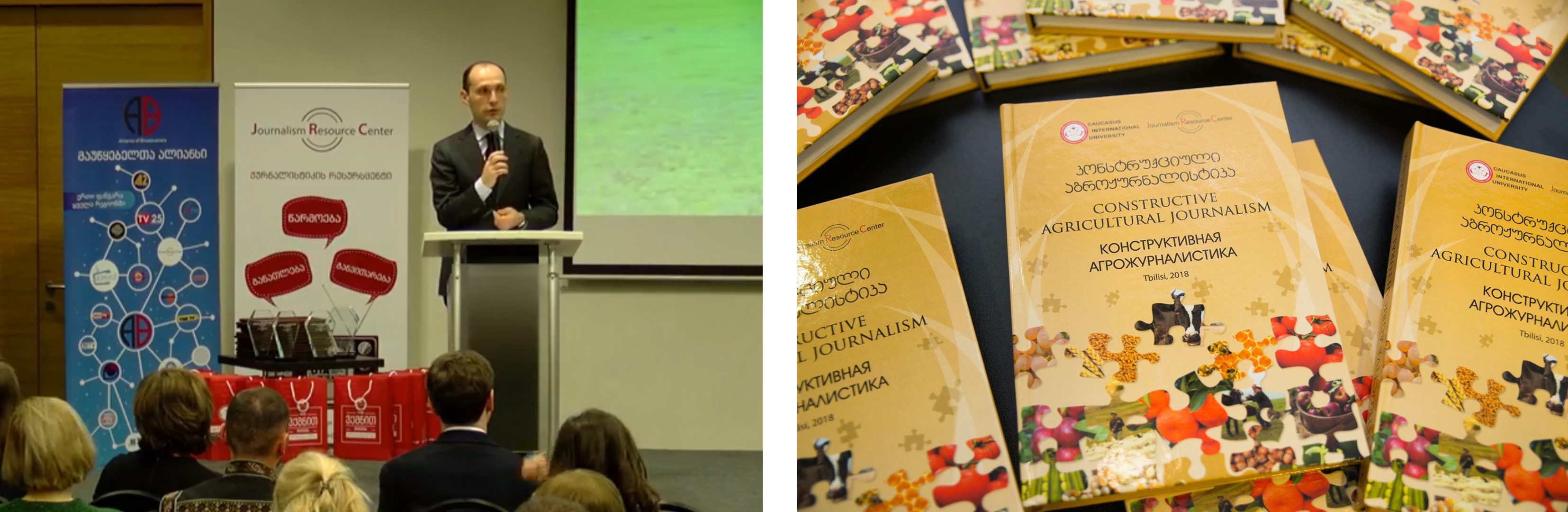
On December 26th, the Journalism Resource Centre presented its second edition of the agri journalism module. About hundred guests from the government, business and academic sphere attended the event.
The Minister of Environmental Protection and Agriculture of Georgia, Levan Davitashvili stated: ‘I am very glad to hear about all the initiatives related to agri journalism. Education is very important in agriculture for ensuring information dissemination for farmers. The door of the Minister of Agriculture is open for you at any time and our partnership with regional media is very important.’
The agri module was created for inclusion in BA in journalism degrees. Now, ten universities across Georgia have the agri journalism module established in their curriculum, lasting one semester with a total of 15 credit hours. Four more universities are about to do the same this year. 369 students have undergone the course in Georgia to date. Now those initiatives are ready for transfer to Armenia and Azerbaijan.
During the event, the Journalism Resource Centre awarded farmers and specialists within the agricultural sector. The Best Female Farmer of the Year award was given to beekeeper Mariam Kiladze; the Best Vet of the Year was Giorgi Tcikhelashvili from Dmanisi, he is 25 years-old who graduated from the Vet Department at Agrarian University and went back to Dmanisi and is working as a vet. The Best Male Farmer award was given to shepherd Giorgi Imerlishvili. Credo and the EBRD were recognized as financial institutions that supports agriculture, and SDC Project Mercy Corps Alliances Caucasus Programme for supporting agri media journalism.
At the end of the event, the Journalism Resource Centre announced the establishment of the Agro Guild, which unites journalists and media organizations, businesses, farmers, public officials, and universities and sets up annual or bi-annual advisory committees. The members of media associations and the JRC also announced that they are planning to establish an Agri TV program, the pilot of which will start in three months.
Follow this link for additional news regarding the event.
A few days ago all Self-Governing cities and municipalities in the country received a recommendation from the Ministry of Regional Development and Infrastructure to appoint an advisor on Gender Equity in each one to support implementation of the Law on Gender Equality 2010 and the action plan.
Two cases of Anthrax were identified in Tsalka Municipality during August 2013. According to the NFA representative Jemal Dekanadze, one cow died due to contracting Anthrax in Beshtasheni Village, Tsalka on August 8th. A blood test sent to Tbilisi Veterinary laboratory was confirmed positive for Anthrax. However, as reported by the Local Independent Vet from Tsalka Municipality, about 5 heads of dead cattle with clinical signs of Anthrax that were not laboratory tested were also observed in the local farms of the village.
Two cows died and a man has been infected due to contracting Anthrax in Patara Toneti Village, Tetritskaro Municipality. According to the representative of the NFA – Shota Poilarashvili the first cow died on July 17th, although the blood samples for laboratory testing were taken only by July 26th. During ten days the infected carcass had been abandoned in the ravine of the village.
Following on from the meeting with Shorena Bziava on May 21st in Kutaisi, Alliances KK met with Davit Narmania, the Minister of Regional Development and Infrastructure of Georgia. The main purpose of the meeting was introducing the Minister with Women’s Room, a new municipal service in Dmanisi, Tetritskaro and Tsalka municipalities, facilitated by the Alliances KK programme. Mr. David was informed about the main idea of WR and the services offered there. The information about the activities, the events carried out and the number of visitors since the establishment of WRs – were also overviewed. GENDER GUIDELINS for VILLAGE REPS with flyers of Women’s Room and Newsletter were presented and discussed.
Two cows died due to contracting Anthrax in Useinkendi, Karabulakhi Community, Dmanisi municipality on 13th May 2013. As the deputy of Gamgebeli Dato Petviashvili stated, a blood sample was taken from only one dead cattle and Tbilisi Veterinary Laboratory has subsequently confirmed the animal death was caused by Anthrax. The local government put Karabulakhi under quarantine for two weeks. The NFA commenced mandatory vaccination in the village and approximately 250 heads of livestock were vaccinated.
On 21st of May a meeting was held with Shorena Bziava, Gender Equality Council secretary at Georgian Parliament in Kutaisi. Alliances KK representatives introduced the programme Gender activities - a new municipal service Women’s Room and Guidelines for the Village Reps.



