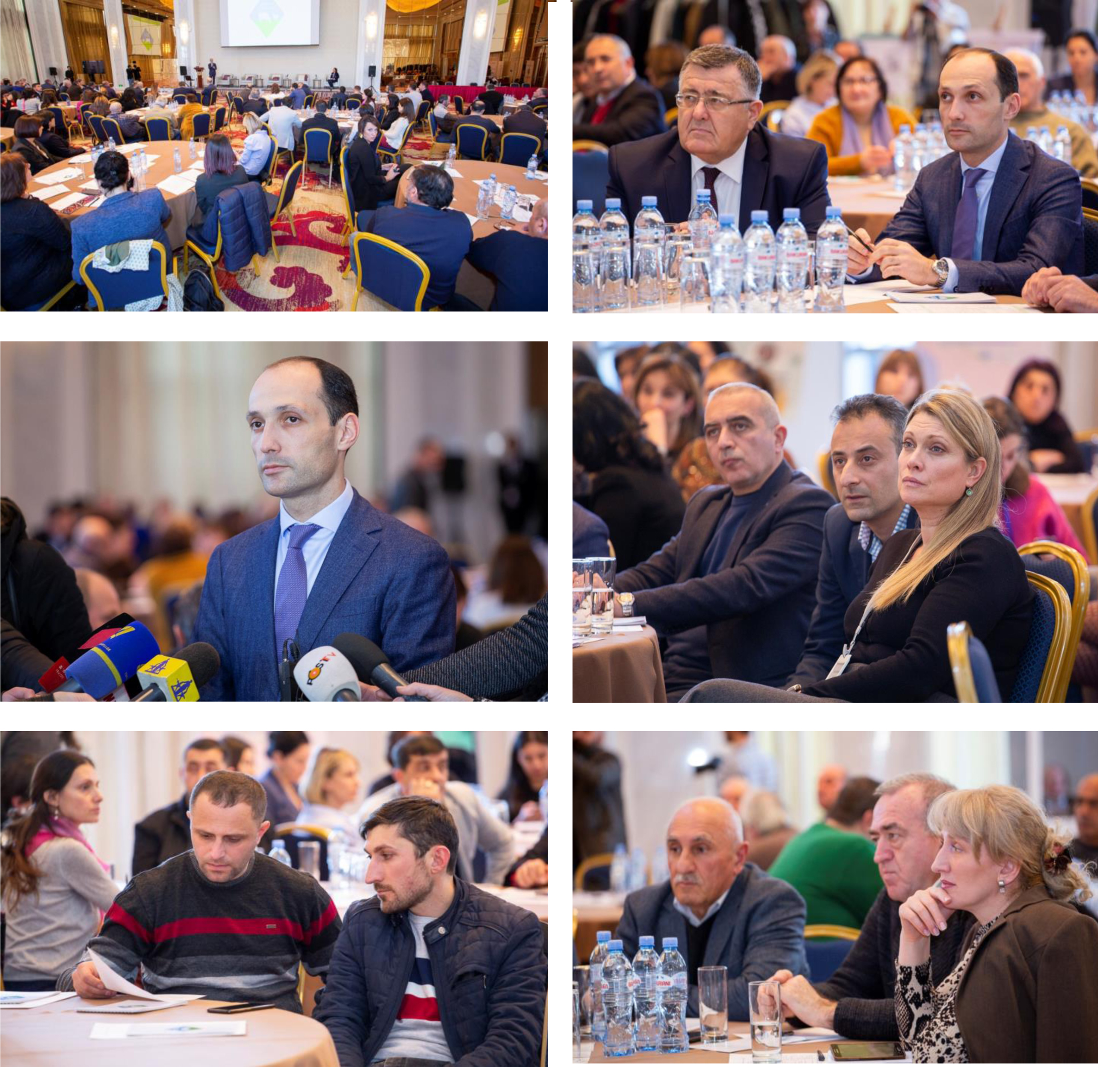
A presentation of a new ‘Georgian Milk’ mark was held on the 22nd of January at Hotels & Preference Hualing Tbilisi.
Up to 150 dairy enterprises and representatives of supermarkets, agri markets, sectoral associations and Government Agencies participated in the meeting.
The new ‘Georgian Milk’mark will distinguish dairy products made from natural raw milk. The ‘Georgian Milk’ mark will be found only on dairy products produced from Georgian natural raw milk and which do not contain milk powder and/or any vegetable oils. The purpose of the mark is to promote products made from Georgian natural raw milk, which will help consumers make informed decisions while buying milk and other dairy products. A recent large national consumer survey by the Caucasus Research Resource Centre of urban consumers across Georgia showed that consumers want to be able to buy ‘ecologically clean’ dairy products, meaning clean milk that comes from healthy grass fed cattle and dairy products produced in clean regulated enterprises. The research found that the majority of consumers had difficulty in identifying or being able to buy such products as these products are currently undifferentiated in shops. The ‘Georgian Milk’ mark will therefore solve this problem.
‘We should disseminate information among local consumers about the importance of Georgian milk. The ‘Georgian Milk’ mark will promote natural raw milk products and the Ministry supports this great initiative, which will increase trust and promote quality production’ – Levan Davitashvili, the Minister of Environmental Protection and Agriculture of Georgia.
Eighteen dairy enterprises have already applied to get the mark. All registered and HACCP certified dairies have the right to apply to use the ‘Georgian Milk’ mark if they produce dairy products using natural raw milk that meets the criteria of the mark. These dairies will then be regularly audited by an independent body and transparent results and enterprise data published online on a www.georgianmilk.ge website which will come online at beginning of March. Ultimately this will help enterprises to overcome unfair competition arising from dairy products produced from milk powder.
‘The current dairy market is saturated with the dairy products produced from powdered milk, that are not differentiated. This mark allows consumers to distinguish between dairy products made from raw milk and powdered milk. This is a great initiative and I am sure it will be a huge step forward to promote clean production in the country and help milk supplier farmers.” – Merab Dzirkvadze, Manager of Thisntskaro + ltd dairy enterprise.
A national promotion campaign conducted by GMA international marketing company will be roll out from the end of next month.
The event is supported by the Ministry of Environmental Protection and Agriculture of Georgia and organized by the Swiss Development and Cooperation (SDC) project, the Alliances Caucasus Programme implemented by Mercy Corps Georgia.
For more details please follow the links:
Agenda.ge
Imedis Dila
The Ministry of Environmental Protection and Agriculture of Georgia
Post TV
Maestro TV
Kvira.ge
The OLMA trade show – a Swiss Agricultural and Food Fair has been held every year since 1943 in St. Gallen, Switzerland. The year’s 74th exhibition was held from 8-18 of October. 623 exhibitors and 375000 visitors attended the show.
The Swiss Agency for Development and Cooperation (SDC) was the one of the exhibitors this year. The SDC created 8 country stands including that of the Swiss Cooperation Office for the South Caucasus.
Name: Natural Produktsia Ltd
Place: Dioknisi Village, Khulo Municipality
Type of business: Cheese Factory
Product: Imeruli Cheese
Suppliers: about 450 women from 13 villages of Khulo
Current production per day: 5 tons of milk (700 kg of cheese)
The Problem
The 450 women now selling milk directly to the milk collectors of the Natural Produktsia Ltd Factory in Dioknisi, Khulo used to make cheese from their milk. Women are responsible for milking the household cattle and making the cheese, butter, sour cream and cottage cheese which is then sold as an important part of the family’s livelihood.
Selling these products however is hard and uncertain. The journey by marshutka to Batumi Agrarian Market can take up to 4 hours on bad roads. It is taken to the market by husbands or other male family members or sent with the driver and met by a relative who then tries to sell it. There is no guarantee of a sale and often the family is forced to accept a low price from the market vendors rather than take it home again.
The NFA announced a tender on September 28th for the construction of two further Bio Security Points of the same design in Dedoplistskaro and Sighnaghi municipalities. The tender winner company was identified on October 5th.
For the first time in Georgia 6 universities will soon offer specialized courses on agricultural journalism.
The universities in Batumi, Kutaisi, Gori, Telavi, Akhaltcikhe and Caucasus International Universities in Tbilisi who already offer academic programmes on journalism, mass communications and agricultural education will now add agro journalism. The course prospective tutors have just had Training of Trainers for two days.
Following work in KK and SJ the Women’s Room model is being replicated in Ajara region, where Ajara Chamber of Commerce and Industry (ACCI) is proving an invaluable partner by opening the first Women’s Room at the Association of Business Women of Ajara (ABWA).
The “Women’s Room” will open up opportunities for the ABWA in terms of coordinating activities, trainings, advocacy raising meetings and information sharing. All these will contribute into stimulating women’s entrepreneurship and economic empowerment and attracting more women members to the association.
The Ministry of Agriculture through the National Food Agency has posted details of the construction of the six Bio Security Points on the Animal Movement Route, the construction of two of which have started this month.
Minister of Agriculture Otar Danelia stated.
“It is very important that concrete steps toward the development of the livestock sector have been taken. Rehabilitation and modernization of the Animal Movement Route has started. Building modern standard Bio Security Points will promote animal health protection and will reduce the spread of animal disease” – he said.