



The first settlement of Svans into Kvemo Kartli took place in 1987. This is when the Svans from landslide-affected Chviberi (higher Svaneti) were resettled in Dmanisi, in the houses built under a government programme. Svans started to introduce their style of life in Kvemo Kartli and establish strong communities in Kvemo Kartli.
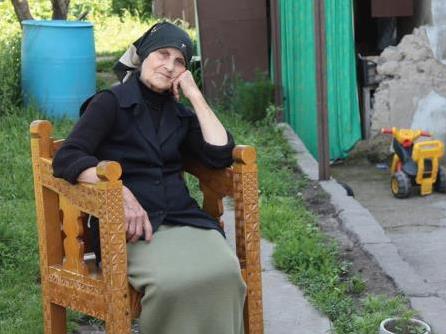
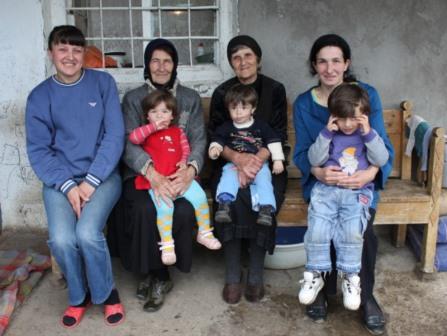
Natela Argvliani and her family are eco-migrants from the village of Etseri in Mestia district; the family moved to Tsalka in 2003 under a government programme. She is the head of the family based on her age. The programme provided some funding for houses and the family managed to purchase a modest two-storey house where Natela lives with her son Nino Kvitsiani her daughter-in-law and her grandchildren who are twins. Natela also has a daughter, Lela, who is married to a Tbilisi resident and lives there. She visits her mother with her husband and son and stays for long periods at Natela’s house as was the case during our visit.
Natela’s daughter-in-law, Nino Kvitsiani lives in Tsalka with Natela. This is not the first displacement for her. Her parents left Svaneti not long before the Abkhazia war. For 7 years the family lived in Gulripshi until they had to flee again — not avalanches but war.
Nino teaches English at a local school and also gives private classes. She married when she was over 30, had already graduated university in Tbilisi and had a job. In addition to Georgian, Nino speaks good Russian and English, has her own opinions about life and her own judgment. She is not very satisfied with life in Tsalka. In her opinion, the town is very scattered from in ethnic standpoint with every group living autonomously and having little interaction with the other groups. One can assume that the cultural life of Tsalka is somewhat narrow for Nino but she does not say this explicitly. Nino is the breadwinner of her large family. She has authority and deliberates upon household strategies. Her husband has not worked for a long time.
Other relatives often visit their family. Natela’s aunt, Margarita Kordzaia, was visiting the family during our visit. Margarita lives in Dmanisi but often comes to visit her children who live in Tsalka and stays at Natela’s place for long periods. Margarita also hails from Svaneti. Young people, as well as the elderly, are unanimous in thinking that it is easier to live in Kvemo Kartli than in Svaneti. That said, however, Margarita and Natela miss their native region very much. They have not been there for several years now but, out of modesty and self-sacrifice, do not voice their wishes giving priority to the children’s opinions and, possibly, accepting the likelihood that they may never be able to see Svaneti again. However, Natela, for example, is intensively involved in household affairs, helps with the raising of her grandchildren and makes, clearly, a not-insubstantial contribution to the household income with her monthly pension.
As Nino works mainly as a teacher, there is no one to take care of the cows and so for this reason, the family has just two with the milk used mainly for their own consumption. Nino told us that they could if they wanted to hire help for milking the cows which is currently handled by Natela, as the work is poorly paid and affordable, paid at ten Lari a month per cow milked morning and evening. 10 Lari in the village is good money and it’s important for them. There is enough milk to make cheese to sell. A blue plastic barrel in which the cheese is stored can be seen outside the house. Cheese is stored in the barrel through the summer and, when the container is full, they close it tight in order to store and sell the cheese in winter when prices are higher. Cheese is also used for barter exchange for other goods and services. Thus, cheese can be referred to as local currency.
In addition to dairy products, potatoes and hay are other sources of income for the family and for people locally. The production of potatoes for other than household consumption, however, requires larger tracts of land and not every resident owns such territory. Producing hay, too, is labour intensive both for home consumption and for sale and requires mowing, drying, gathering and storage or loading for delivering to buyers and selling. So the women look after the cows and make cheese and this daily work feeds the families and is the main source of income for this family and for almost everyone else here.
From the ISET Economist news (http://www.iset.ge/news/?s=survival&lang=en)
By Nino Mosiashvili
The conclusion of the Association Agreement (AA) with the European Union was euphorically acclaimed by Georgian media as well as political and economic decision makers. Part of the AA is the Deep and Comprehensive Free Trade Agreement (DCFTA). The DCFTA is intended to liberalize trade between Georgia and the EU by lowering tariffs and reducing non-tariff barriers. For agriculture, the most relevant changes relate to food safety (bacterial contaminants, pesticides, inspection, and labeling) as well as animal and plant health (phytosanitation). For the manufacturing sector, the removal of so-called “technical barriers to trade” is similarly important, with the goal being to prevent the usage of technical standards as a means to protect domestic markets from foreign competition. “If regulations are set arbitrarily, they could be used as an excuse for protectionism”, states the World Trade Organization on its homepage.
Livestock transhumance will no longer disturb Tsintskaro Village population in Tetritskaro Municipality. The local Municipal DRR Working Group initiated a new infrastructure project which will solve the problems related to the seasonal transhumance in this particular village.
From the ISET Economist news (http://www.iset.ge/news/?p=3311)
By Eric Livny
(Summary of a debate hosted by ISET as part of SDC-supported Inclusive Growth Dialog series.)
There are many reasons to love the concept of farmer cooperation (and cooperation more generally). To begin with, there is a great aesthetic value in seeing people coming together, sharing resources and helping each other. After all, instinctive collectivism was the basic condition of human existence from time immemorial. But, there are also powerful economic reasons for farmer cooperation.
The Road – a beautifully shot documentary capturing the reality and dichotomies of the people who use the ancient transhumance route; the lifeline of livestock in Georgia
A Memorandum of Understanding has been signed between the Ministry of Regional Development and Infrastructure (MRDI) and the Swiss Development Cooperation project the Mercy Corps Georgia implemented, Alliances Lesser Caucasus Programme (ALCP) in Kvemo Kartli, The aim of the memorandum is to support the ongoing outreach at local government level of practical implementation of the 2010 Georgian Gender Equality Law which will greatly aid in the general development of rural Georgian municipalities.
From the ISET Economist news (http://www.iset.ge/news/?p=3056)
By Tim Stewart
As Georgia embarks on an ambitious program to develop farmer organizations, it is worth considering both the positive and negative lessons from the experience of similar initiatives, both in Georgia and elsewhere in the developing/transition context. The piece by Tim Stewart, originally published on www.springfieldcentre.com, identifies some of the main reasons for the failure of start-up farmer organizations. The challenge for Georgia is to learn from these mistakes in planning and implementation, and ensure improved coordination among the many cooks involved (the newly created Agency for the Development of Agricultural Cooperatives, the Ministry of Agriculture, international donors, NGOs, and farmer associations).



