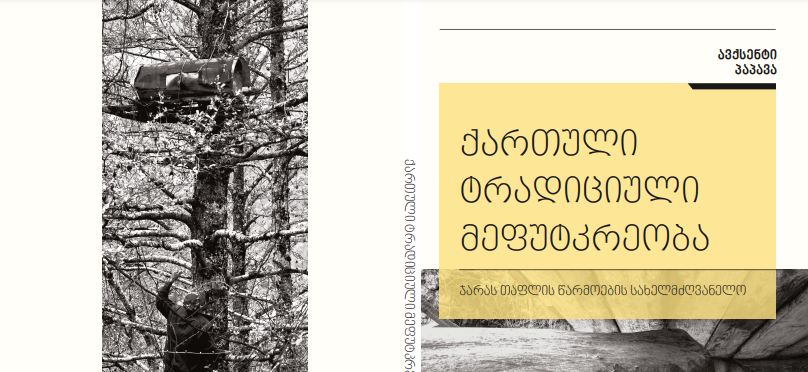
Georgian Traditional Beekeeping: Jara Honey Production is a new textbook now available for VET colleges who include a Jara component in their beekeeping courses. It is part of making the Jara beekeeping course material an accredited component in its own right from September this year.
The author Aleko Papava, who is a competent, reliable and respected beekeeper teacher and Head of the Georgian Beekeepers Union, wrote the book together with education specialists on behalf of the Georgian Beekeepers Union and Jara Beekeepers Association.
The Scientific Research Centre of Agriculture of the Ministry of Environmental Protection and Agriculture reviewed and acknowledged the book positively.
‘The book is written in a highly professional manner, materials meet the demand of the beekeeping sector in terms of bio honey production and provide comprehensive information about all the topics for studying Jara Honey Production’ – says the Centre in their letter sent to the GBU.
In June 2021, thirteen VET college representatives from seven regions of Georgia attended a Training of Trainers in Jara Honey Production and later received jara equipment. Now eight of them are integrating aspects of Jara beekeeping into different subjects of the beekeeping programmes to 106 students. Five more colleges will start soon. This textbook means that Jara Beekeeping will be taught as a separate accredited component of these courses. The newly established Vocational Skills Agency, National Center for Educational Quality Enhancement and sectoral skills organization Agro Duo are all supporting Jara teaching integration in the VET colleges.
Linked resources: Jara Honey Production Handbook; Bio Certification Guidelines for Beekeepers; www.honeyofgeorgia.com; Discover Georgia: The Land of the Oldest Honey.
Armenians have been living in Kvemo Kartli for centuries. According to the 2002 census 31,777 out of 497,530 Kvemo Kartli residents were Armenians. The number of Armenians is highest in Tsalka where 11,484 Armenians live, out of a total population of 20977. The advent of Armenians in Georgia was related to the movement of people during the Arab, Turk-Seljuk, Mongolian, Turkmen, Kizilbash, Ottoman Turk and other invasions. Several major settlements of Armenians took place in 1828-1829, during the Russian-Turkish war
Azerbaijanis living in Kvemo Kartli are Turkic-speaking people representing the legacy of the conquerors that came to this area at different times. in the 1926 Census they were referred to as Azerbaijanis. The Azeri population that settled in Kartli is comprised of two streams of migrants: 1. The Turkish-speaking population that was resettled between 15th-18th centuries; they went through the heaviest psychological and physical stress before they adapted to the new place. 2. Migrants who moved from one place to another to improve living conditions having adapted to the new environment. Currently the Azeri population in Georgia numbers 224,606. They mainly reside in Bolnisi, Dmanisi, Gardabani and Marneuli districts, mostly in district centers apart from in Dmanisi muniiciaplity where there are many Azeri villages. Some live in Tetritskaro and Tsalka districts.
In 1980’s the planned settlement of a large groups of eco-migrant Ajarians and Svanetians started in Tetritskaro and Tsalka municipalities. There were several streams of eco-migration up to 2003. The advent of these incomers has left its mark on Kvemo Kartli. It became richer from an ethnic, religious and language standpoint, however it also gave rise to new problems and challenges for new and old residents alike in seeking to adapt to the new cultural diversity.
The first settlement of Svans into Kvemo Kartli took place in 1987. This is when the Svans from landslide-affected Chviberi (higher Svaneti) were resettled in Dmanisi, in the houses built under a government programme. Svans started to introduce their style of life in Kvemo Kartli and establish strong communities in Kvemo Kartli.
In 2011 Alliances KK facilitated establishment of DRR Municipal Working Groups in Dmanisi, Tsalka and Tetritskaro municipalities. These groups remain to be the main point for planning and implementing of prevention measures to reduce livestock related disaster risks.