



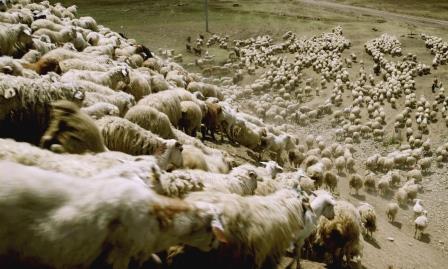
The villagers of Tsintskaro village have suffered for years from the twice yearly flow of more than 100,000 sheep, cattle, goats, donkeys, horses and shepherd dogs straight past their gates. The problem has been in impasse for years with no real ownership of the issue by the myriad actors involved. Now, the local government has spearheaded the movement to solve the problem calling together support from a group including the MOA, MOE, the Regional Government and Shepherds Association which has been working for three years to improve coordination and bring the matter of the Animal Movement Route to public attention.
Transhumance is a major part of the livestock system for sheep and to a lesser extent cattle in Georgia. Approximately 300,000 animals move twice yearly, up to summer pasture and back down to winter pasture on long established routes in spring and early autumn. For residents of Tsintskaro Village, Tetritskaro municipality this has meant living with a three week long flood of animals moving through the village. The route usually passes around settlements but a rocky ravine has meant that there was no access for the flocks other than the main road through the village. The obstruction, noise and dirt makes life intolerable for the villagers who can barely leave their homes and it is far from pleasant for the Shepherds and animals themselves as they are harassed by beeping cars as they move through flock after flock as quickly as they can.
The issue was recently publicized in the Eco Films Documentary ‘The Road’ (please follow the link) which has further publicized the plight of the village, the problems encountered by the Shepherds and the importance of the route and the movement of animals for the agricultural sector in Georgia. Luckily excellent coordination, the result of years of facilitation between local government, regional government, relevant Ministries, the private sector and the Shepherds Association through a regional Advisory Committee, has led to the commencement of work on a 4150 meters long, bypass route.
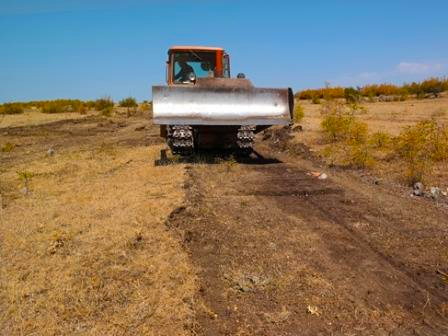
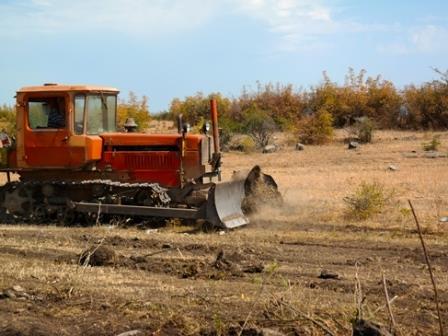
The work will include removing vegetation and establishing a road through the rocky ravine as well as signposting the route and fencing crop land to protect it from the herds. The work is expected to be completed by early October hopefully in time for the winter migration back down from the high pastures. An opening ceremony will be held to which media and all those involved in making the project happen will be invited. The solution to the Tsinskaro Problem which was considered for years one of the most intractable problems in the wider context of the AMR will give hope to many and marks the beginning of a regeneration of the AMR, a vital lifeline of the livestock system in Georgia.
Construction of the two Bio Security Points (BSP) on the Animal Movement Routes in Marneuli and Rustavi is now on a final stage.
Each 2000 square meters point is already concreted and fenced and the sheep dips and cattle showers are ready and the site office in place. The 50 ton galvanized water Tanks imported from the UK are installed. For both points the NFA will hire staff including a veterinarian.
The OLMA trade show – a Swiss Agricultural and Food Fair has been held every year since 1943 in St. Gallen, Switzerland. The year’s 74th exhibition was held from 8-18 of October. 623 exhibitors and 375000 visitors attended the show.
The Swiss Agency for Development and Cooperation (SDC) was the one of the exhibitors this year. The SDC created 8 country stands including that of the Swiss Cooperation Office for the South Caucasus.
Name: Natural Produktsia Ltd
Place: Dioknisi Village, Khulo Municipality
Type of business: Cheese Factory
Product: Imeruli Cheese
Suppliers: about 450 women from 13 villages of Khulo
Current production per day: 5 tons of milk (700 kg of cheese)
The Problem
The 450 women now selling milk directly to the milk collectors of the Natural Produktsia Ltd Factory in Dioknisi, Khulo used to make cheese from their milk. Women are responsible for milking the household cattle and making the cheese, butter, sour cream and cottage cheese which is then sold as an important part of the family’s livelihood.
Selling these products however is hard and uncertain. The journey by marshutka to Batumi Agrarian Market can take up to 4 hours on bad roads. It is taken to the market by husbands or other male family members or sent with the driver and met by a relative who then tries to sell it. There is no guarantee of a sale and often the family is forced to accept a low price from the market vendors rather than take it home again.
The NFA announced a tender on September 28th for the construction of two further Bio Security Points of the same design in Dedoplistskaro and Sighnaghi municipalities. The tender winner company was identified on October 5th.
For the first time in Georgia 6 universities will soon offer specialized courses on agricultural journalism.
The universities in Batumi, Kutaisi, Gori, Telavi, Akhaltcikhe and Caucasus International Universities in Tbilisi who already offer academic programmes on journalism, mass communications and agricultural education will now add agro journalism. The course prospective tutors have just had Training of Trainers for two days.
Following work in KK and SJ the Women’s Room model is being replicated in Ajara region, where Ajara Chamber of Commerce and Industry (ACCI) is proving an invaluable partner by opening the first Women’s Room at the Association of Business Women of Ajara (ABWA).
The “Women’s Room” will open up opportunities for the ABWA in terms of coordinating activities, trainings, advocacy raising meetings and information sharing. All these will contribute into stimulating women’s entrepreneurship and economic empowerment and attracting more women members to the association.



