



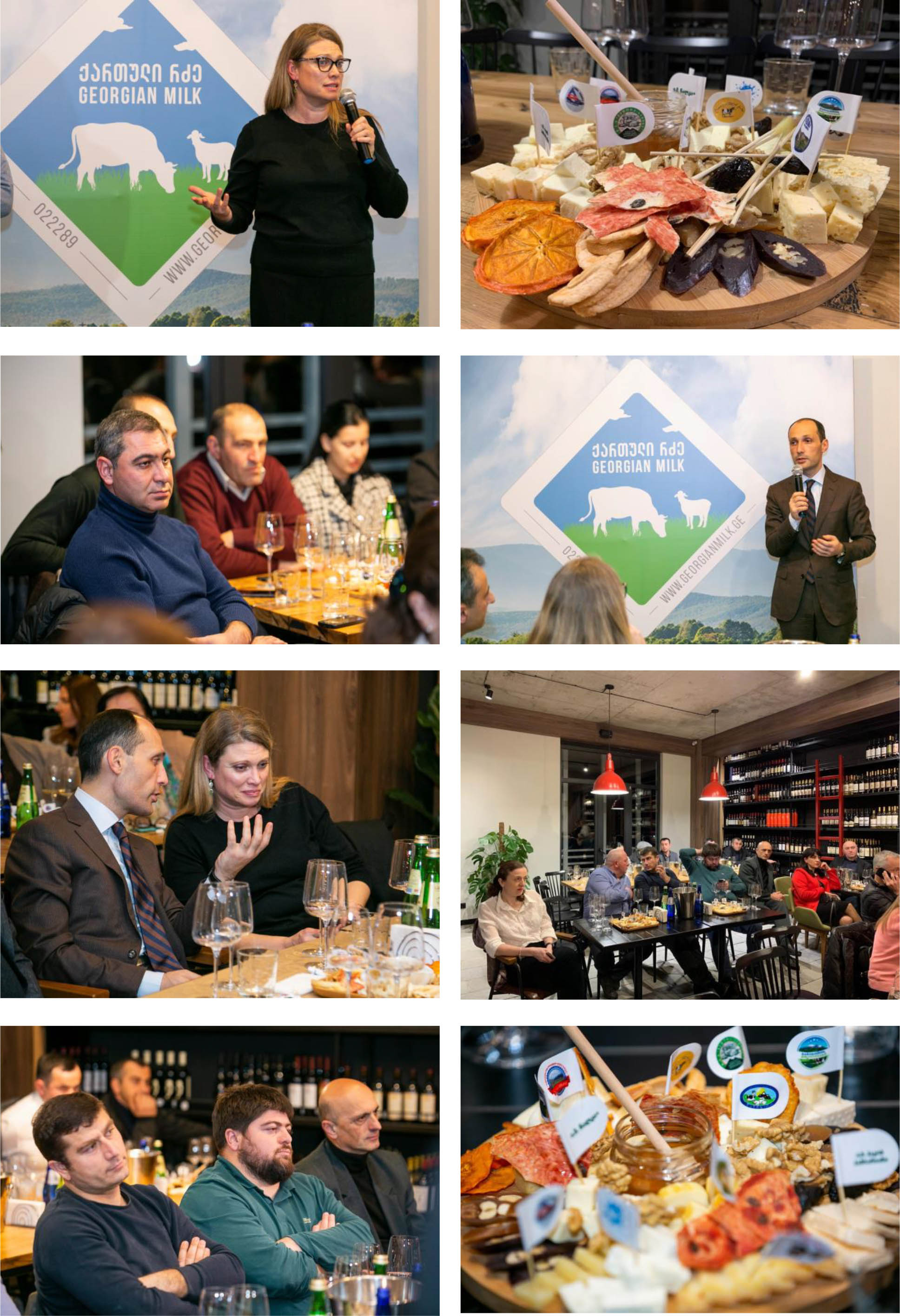
On 16th of December 2019, the Georgian Milk mark organized a Georgian Cheese and Wine evening at 8000 Vintages to introduce cheese with Georgian Milk mark (GMM) to the supermarkets and encouraged them to pass information on the advantages of GMM cheese to consumers. Cheese with Georgian Milk mark does not contain milk powder or any vegetable oils, it has laboratory analysis and is produced in the enterprises which are HACCP certified.
The Guests had the opportunity to taste different types of cheese made from natural raw milk produced by thirteen enterprises: Milken Ltd, Tsintskaro + Ltd, I.E Hakob Hambaryan, I.E Karen Simonyan, I.E Tsolak Grigoryan, Tsifora –Smatskhe Ltd, Tsalka +Ltd, Dairy Products Company Tsezari Ltd, Gocha Gagashvili – brand name Tsivis Kveli, Levan Bejanishvili-brand name Shuamta, Badri Gogoladze – brand name Cheese Hut, Coop. Tanadgoma, Coop. Disvelli. The Information per enterprise is available on www.georgianmilk.ge. The website allows consumers to look up the products they are buying using a unique register number printed on a label.
The evening of Georgian Cheese and Wine was attended by Mr. Levan Davitashvili, the Minister of Environment Protection and Agriculture of Georgia, by the Swiss Agency for Development and Cooperation Project Alliances Caucasus Program (ALCP) implemented by Mercy Corps, Georgian Milk Mark Project Administrator - Business Institute of Georgia and Marketing Company GMA Representative, the supermarkets and the dairies using the Georgian Milk mark.
The evening was headed by Zaza Grigalashvili, an '8000 Vintages' Sommelier, who spoke about Georgian cheese and wine pairing.
Helen Bradbury, ALCP Team Leader: ‘We have private sector cheese enterprises in the room from different regions, these are a real dairy businesses operating for years and years. It is very important that this is Georgian Milk from Georgian cows who eat Georgian grass. Consumers want to eat natural, healthy, good country food which comes from this beautiful land, from this beautiful clean water, from happy cows and are made in communities living in countryside. Today we are at 8000 Vintages and we all know the history of wine. If you want ‘Qvevri’ wine or European style wine we know from where it comes from its name and the consumer can choose according wine value and its good for the producer, they can add more value and then this value goes back to the jobs, factories in the communities. So in the dairy sector it is going to be the same: as cheese will have the name, taste, value, style and its started to develop, the money supporting these factories goes back to women who are supplying milk, their families, they are putting money to their children education and investing in their life'.
Levan Davitashvili, The Minister of MEPA: ‘I think the most difficult sector in Georgia is adairy sector and we have a lot to do together. A good presentation of a final product the market and how we bring cheese to the consumer is very important. We can say that competition between the enterprises is unfair, but we work on this via new the regulations to change the situation in the sector, we also empower our laboratories to have better quality and safe products. Today we have Georgian Milk mark presentation which is a very good idea for providing information to the consumers about dairy products, which also gives advantages to producer'.
The Products with the mark are available in Madagoni, Spar, Ori Nabiji, Nikora, Zgapari, Fresco, Carrefour, and Goodwill supermarket chains.
Locals, interested parties including the Minister of Agriculture of Ajara and tourists, in the height of the Batumi summer run enjoyed a new addition to the summer time calendar of events with the first Ajara Honey Festival on August 22nd on Batumi Boulevard. The festival was organized by The Beekeepers Association of Ajara, an entity belonging to the Ajara Chamber of Commerce and Industry.
Ajara is a major producer of honey in Georgia and the programme has completed a sector survey and commenced numerous interventions. The festival was a first step in promoting Ajara as a producer of high quality honey and developing a cohesive image of honey production in the region. Beekeeping in Ajara has been practiced for centuries and still includes the capturing of wild swarms and cultivating of honey in logs known as ‘Jara’.
The National Food Agency representatives met with entrepreneurs of honey and meat sectors in Kvemo Kartli and Ajara regions in July. The aim of the meetings was to inform local producers on the regulations and required standards for the quality production of meat and honey products in accordance with FS&H standards.
Food Safety and Hygiene in the Agrarian Market of Batumi was the main topic of the ALCP AJ Advisory Committee’s second meeting in Ajara region. The discussion concerned the incompliance of existing situation in Market with FS&H standards and possible risks derived from the meat and dairy products purchased there. Due to the importance and complexity of the issue, key market stakeholders such as representatives of Ajara Government, NFA and Agrarian Market participated in the meeting.
“Women in Georgia – Tradition and Contemporaneity” is a short documentary film prepared by ‘Netgazeti’ (online newspaper) about women living in Ghordjomi Community (Khulo Municipality, Ajara). Ghordjomi is one of the largest Muslim communities in Ajara and is known for its early marriage traditions, and other strict rules and attitudes towards women. The film describes the harsh daily routine of the women starting from 6 am in the morning with taking care of the cattle, children, household and the restrictions they face in daily life.
The ALCP AJ programme’s Focus Group Survey and Gender Analysis captured these issues and also noted the consequent effect on the participation of women in the decision-making processes at the community and local governmental levels which is chronically low.
The first meeting of the Regional DRR Working Group was carried out at the KK Governor Office.
The Governor of Kvemo Kartli - Paata Khizanashvili encouraged decision makers from all municipalities of the region to pay more attention on issues linked with Animal Disease Control, Pasture Usage and Disaster Risk Reduction. He noted that the municipal leaders should understand these are the issues of high importance and the new municipal working groups should have strong communication with the Governor’s office and with other municipalities of Kvemo Kartli.
By now, all seven municipalities of Kvemo Kartlli have DRR working groups coordinated by the regional government.
A new project “Closer to Nature” was launched by Batumi Botanical Garden facilitated by ALCP AJ to promote 165 school student’s involvement in biodiversity and environmental protection activities.



