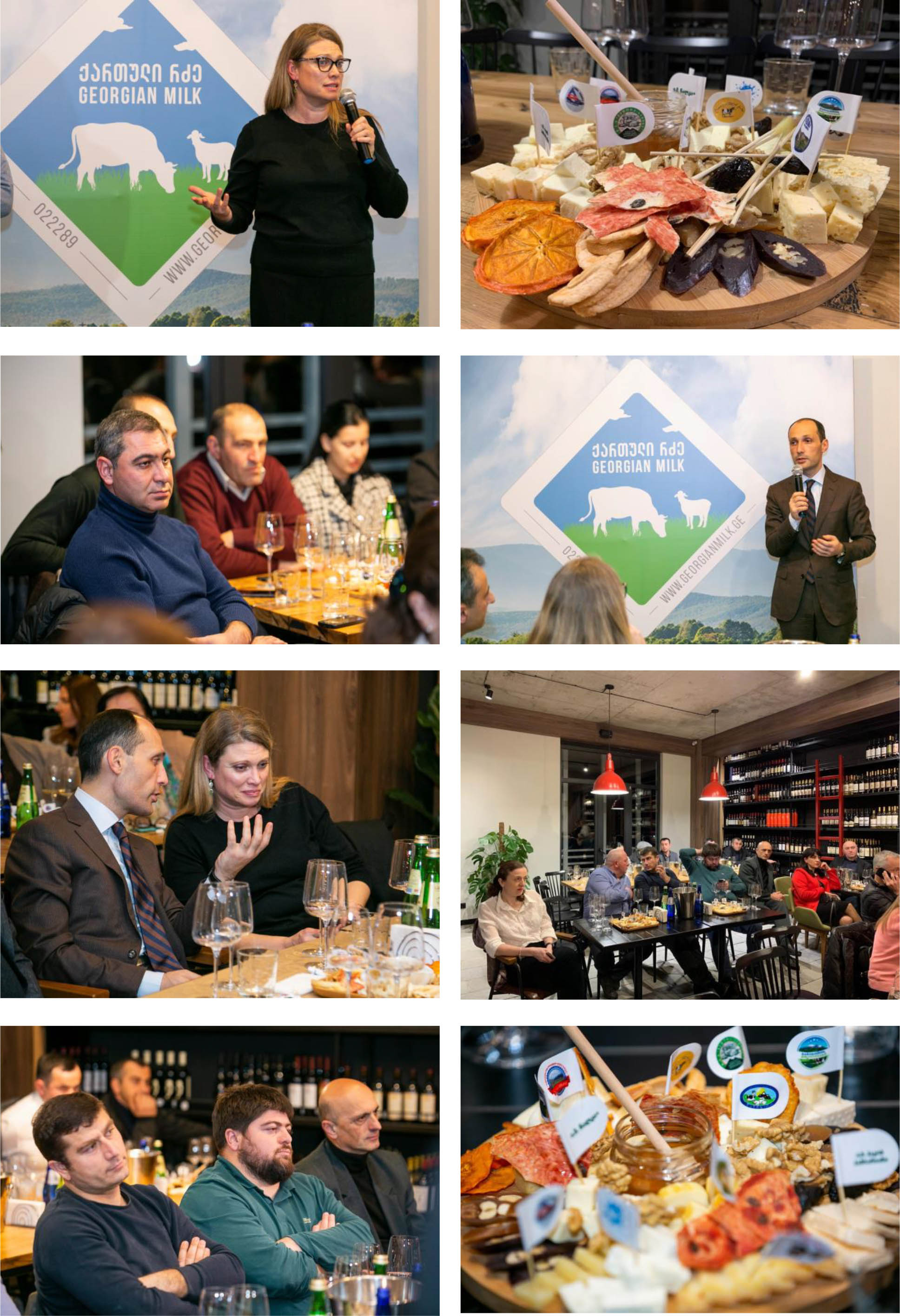
On 16th of December 2019, the Georgian Milk mark organized a Georgian Cheese and Wine evening at 8000 Vintages to introduce cheese with Georgian Milk mark (GMM) to the supermarkets and encouraged them to pass information on the advantages of GMM cheese to consumers. Cheese with Georgian Milk mark does not contain milk powder or any vegetable oils, it has laboratory analysis and is produced in the enterprises which are HACCP certified.
The Guests had the opportunity to taste different types of cheese made from natural raw milk produced by thirteen enterprises: Milken Ltd, Tsintskaro + Ltd, I.E Hakob Hambaryan, I.E Karen Simonyan, I.E Tsolak Grigoryan, Tsifora –Smatskhe Ltd, Tsalka +Ltd, Dairy Products Company Tsezari Ltd, Gocha Gagashvili – brand name Tsivis Kveli, Levan Bejanishvili-brand name Shuamta, Badri Gogoladze – brand name Cheese Hut, Coop. Tanadgoma, Coop. Disvelli. The Information per enterprise is available on www.georgianmilk.ge. The website allows consumers to look up the products they are buying using a unique register number printed on a label.
The evening of Georgian Cheese and Wine was attended by Mr. Levan Davitashvili, the Minister of Environment Protection and Agriculture of Georgia, by the Swiss Agency for Development and Cooperation Project Alliances Caucasus Program (ALCP) implemented by Mercy Corps, Georgian Milk Mark Project Administrator - Business Institute of Georgia and Marketing Company GMA Representative, the supermarkets and the dairies using the Georgian Milk mark.
The evening was headed by Zaza Grigalashvili, an '8000 Vintages' Sommelier, who spoke about Georgian cheese and wine pairing.
Helen Bradbury, ALCP Team Leader: ‘We have private sector cheese enterprises in the room from different regions, these are a real dairy businesses operating for years and years. It is very important that this is Georgian Milk from Georgian cows who eat Georgian grass. Consumers want to eat natural, healthy, good country food which comes from this beautiful land, from this beautiful clean water, from happy cows and are made in communities living in countryside. Today we are at 8000 Vintages and we all know the history of wine. If you want ‘Qvevri’ wine or European style wine we know from where it comes from its name and the consumer can choose according wine value and its good for the producer, they can add more value and then this value goes back to the jobs, factories in the communities. So in the dairy sector it is going to be the same: as cheese will have the name, taste, value, style and its started to develop, the money supporting these factories goes back to women who are supplying milk, their families, they are putting money to their children education and investing in their life'.
Levan Davitashvili, The Minister of MEPA: ‘I think the most difficult sector in Georgia is adairy sector and we have a lot to do together. A good presentation of a final product the market and how we bring cheese to the consumer is very important. We can say that competition between the enterprises is unfair, but we work on this via new the regulations to change the situation in the sector, we also empower our laboratories to have better quality and safe products. Today we have Georgian Milk mark presentation which is a very good idea for providing information to the consumers about dairy products, which also gives advantages to producer'.
The Products with the mark are available in Madagoni, Spar, Ori Nabiji, Nikora, Zgapari, Fresco, Carrefour, and Goodwill supermarket chains.
The Memorandum of Understanding was signed between the Minister of Agriculture, the National Food Agency and SDC funded, Mercy Corps Georgia implemented ALCP on March 31st 2015. Within the framework of this memorandum ALCP will facilitate the building of two Bio-security yards with water points on the Animal Movement Route in Kvemo Kartli region, another three Bio-security yards will be financed from the State Budget.
The advisors from 5 municipalities of Ajara were trained on how to increase women participation in community meetings. Following the training facilitated by ALCP AJ, they worked with the Village Representatives and as a result of their activities, the attendance of women in these meetings has increased by 10-15%.
Very soon the Kvemo Kartli Region will have a new regional mechanism for Disaster Risk Reduction implemented by Local municipalities and the Kvemo Kartli Governor’s office. The Governor of Kvemo Kartli Paata Khizanishvili discussed this topic with the Gamgebelies of the region, deputy governors, the Mayor of Rustavi City and representatives of Alliances Lesser Caucasus Programme (ALCP) on March 11, 2015. The importance of regional coordination and the necessity of creating working groups in all municipalities were highlighted during the meeting.
The Advisory Committee was established in Ajara, which is supposed to be a forum for regional players representing national, local and regional government, civil society and the private sector to tackle key issues in agriculture sector. The participants discussed the role of the Self-governments in Disaster Risk Reduction, wildlife related issues in the region and also clarified the functions of the newly formed Municipal DRR Working Group in five municipalities of Ajara.
A kindergarten was opened on February 17th in Boslebi Village, Dmanisi municipality as a result of facilitation by the Dmanisi Women’s Room. The Kindergarten will serve 30 children not only Georgians from Boslebi Village but also from neighbor Kakliani Village which is mainly inhabited by Azeris. Four local women will be employed there.
From the ISET Economist news (http://www.iset.ge/news/?p=4633)
By Eric Livny
The “do no harm” (primum non nocere) principle is well known to students of medical schools. It is one of the most fundamental maxims in medicine, as formulated, for example, in the Epidemics book of the Hippocratic Collection:
“The physician must … have two special objects in view with regard to disease, namely, to do good or to do no harm“.
Doctors are taught that medical interventions are not risk-free. Thus, when facing a “problem” one should consider whether to use a particular procedure (e.g. surgery or chemical treatment) or do NOTHING.
Not surprisingly, this very principle has applications in many fields other than healthcare. And it is high time for this principle to be studied and applied in Georgian policymaking.