



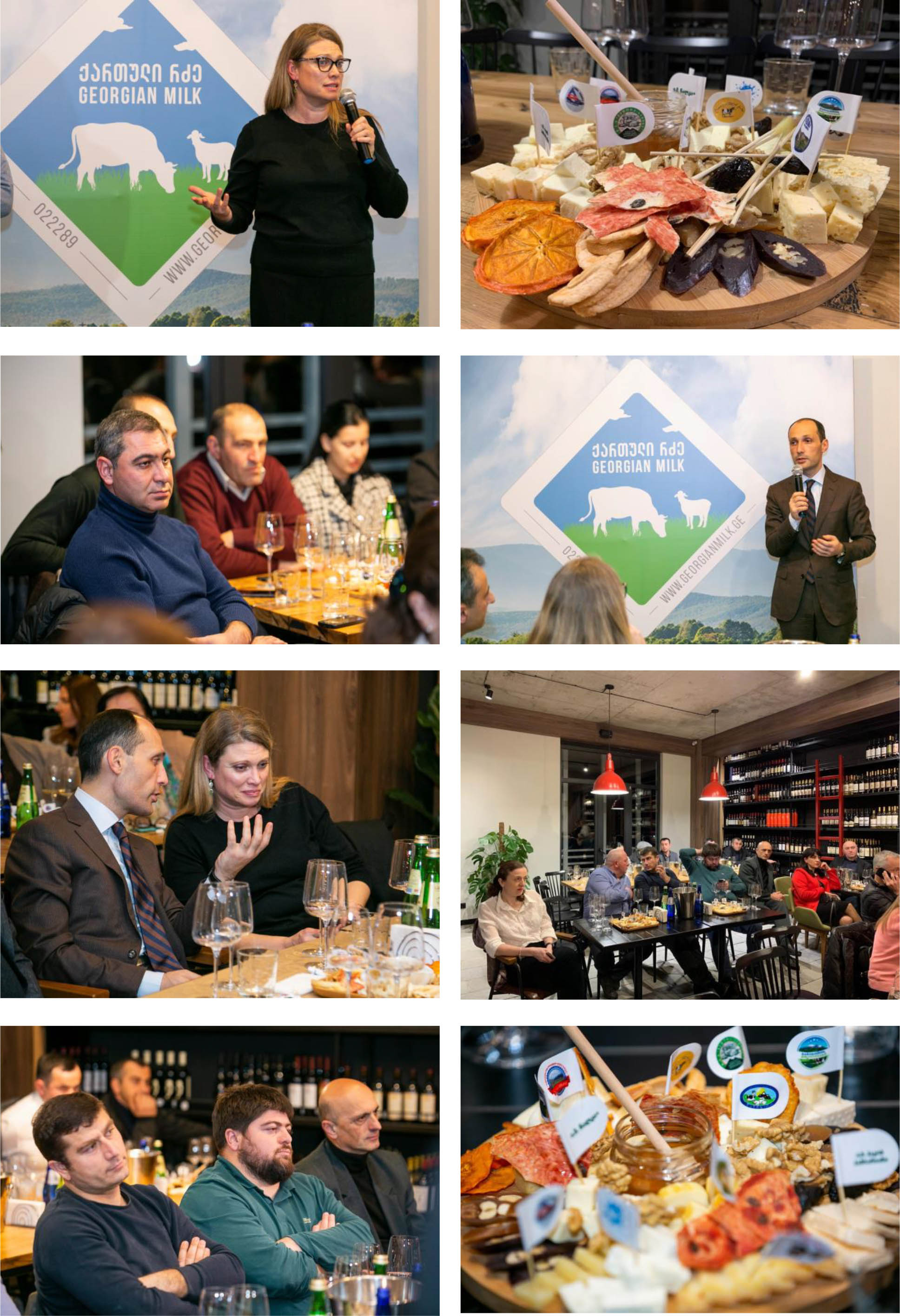
On 16th of December 2019, the Georgian Milk mark organized a Georgian Cheese and Wine evening at 8000 Vintages to introduce cheese with Georgian Milk mark (GMM) to the supermarkets and encouraged them to pass information on the advantages of GMM cheese to consumers. Cheese with Georgian Milk mark does not contain milk powder or any vegetable oils, it has laboratory analysis and is produced in the enterprises which are HACCP certified.
The Guests had the opportunity to taste different types of cheese made from natural raw milk produced by thirteen enterprises: Milken Ltd, Tsintskaro + Ltd, I.E Hakob Hambaryan, I.E Karen Simonyan, I.E Tsolak Grigoryan, Tsifora –Smatskhe Ltd, Tsalka +Ltd, Dairy Products Company Tsezari Ltd, Gocha Gagashvili – brand name Tsivis Kveli, Levan Bejanishvili-brand name Shuamta, Badri Gogoladze – brand name Cheese Hut, Coop. Tanadgoma, Coop. Disvelli. The Information per enterprise is available on www.georgianmilk.ge. The website allows consumers to look up the products they are buying using a unique register number printed on a label.
The evening of Georgian Cheese and Wine was attended by Mr. Levan Davitashvili, the Minister of Environment Protection and Agriculture of Georgia, by the Swiss Agency for Development and Cooperation Project Alliances Caucasus Program (ALCP) implemented by Mercy Corps, Georgian Milk Mark Project Administrator - Business Institute of Georgia and Marketing Company GMA Representative, the supermarkets and the dairies using the Georgian Milk mark.
The evening was headed by Zaza Grigalashvili, an '8000 Vintages' Sommelier, who spoke about Georgian cheese and wine pairing.
Helen Bradbury, ALCP Team Leader: ‘We have private sector cheese enterprises in the room from different regions, these are a real dairy businesses operating for years and years. It is very important that this is Georgian Milk from Georgian cows who eat Georgian grass. Consumers want to eat natural, healthy, good country food which comes from this beautiful land, from this beautiful clean water, from happy cows and are made in communities living in countryside. Today we are at 8000 Vintages and we all know the history of wine. If you want ‘Qvevri’ wine or European style wine we know from where it comes from its name and the consumer can choose according wine value and its good for the producer, they can add more value and then this value goes back to the jobs, factories in the communities. So in the dairy sector it is going to be the same: as cheese will have the name, taste, value, style and its started to develop, the money supporting these factories goes back to women who are supplying milk, their families, they are putting money to their children education and investing in their life'.
Levan Davitashvili, The Minister of MEPA: ‘I think the most difficult sector in Georgia is adairy sector and we have a lot to do together. A good presentation of a final product the market and how we bring cheese to the consumer is very important. We can say that competition between the enterprises is unfair, but we work on this via new the regulations to change the situation in the sector, we also empower our laboratories to have better quality and safe products. Today we have Georgian Milk mark presentation which is a very good idea for providing information to the consumers about dairy products, which also gives advantages to producer'.
The Products with the mark are available in Madagoni, Spar, Ori Nabiji, Nikora, Zgapari, Fresco, Carrefour, and Goodwill supermarket chains.
Armenians have been living in Kvemo Kartli for centuries. According to the 2002 census 31,777 out of 497,530 Kvemo Kartli residents were Armenians. The number of Armenians is highest in Tsalka where 11,484 Armenians live, out of a total population of 20977. The advent of Armenians in Georgia was related to the movement of people during the Arab, Turk-Seljuk, Mongolian, Turkmen, Kizilbash, Ottoman Turk and other invasions. Several major settlements of Armenians took place in 1828-1829, during the Russian-Turkish war
Azerbaijanis living in Kvemo Kartli are Turkic-speaking people representing the legacy of the conquerors that came to this area at different times. in the 1926 Census they were referred to as Azerbaijanis. The Azeri population that settled in Kartli is comprised of two streams of migrants: 1. The Turkish-speaking population that was resettled between 15th-18th centuries; they went through the heaviest psychological and physical stress before they adapted to the new place. 2. Migrants who moved from one place to another to improve living conditions having adapted to the new environment. Currently the Azeri population in Georgia numbers 224,606. They mainly reside in Bolnisi, Dmanisi, Gardabani and Marneuli districts, mostly in district centers apart from in Dmanisi muniiciaplity where there are many Azeri villages. Some live in Tetritskaro and Tsalka districts.
In 1980’s the planned settlement of a large groups of eco-migrant Ajarians and Svanetians started in Tetritskaro and Tsalka municipalities. There were several streams of eco-migration up to 2003. The advent of these incomers has left its mark on Kvemo Kartli. It became richer from an ethnic, religious and language standpoint, however it also gave rise to new problems and challenges for new and old residents alike in seeking to adapt to the new cultural diversity.
The first settlement of Svans into Kvemo Kartli took place in 1987. This is when the Svans from landslide-affected Chviberi (higher Svaneti) were resettled in Dmanisi, in the houses built under a government programme. Svans started to introduce their style of life in Kvemo Kartli and establish strong communities in Kvemo Kartli.
In 2011 Alliances KK facilitated establishment of DRR Municipal Working Groups in Dmanisi, Tsalka and Tetritskaro municipalities. These groups remain to be the main point for planning and implementing of prevention measures to reduce livestock related disaster risks.



