



Azerbaijanis living in Kvemo Kartli are Turkic-speaking people representing the legacy of the conquerors that came to this area at different times. in the 1926 Census they were referred to as Azerbaijanis. The Azeri population that settled in Kartli is comprised of two streams of migrants: 1. The Turkish-speaking population that was resettled between 15th-18th centuries; they went through the heaviest psychological and physical stress before they adapted to the new place. 2. Migrants who moved from one place to another to improve living conditions having adapted to the new environment. Currently the Azeri population in Georgia numbers 224,606. They mainly reside in Bolnisi, Dmanisi, Gardabani and Marneuli districts, mostly in district centers apart from in Dmanisi muniiciaplity where there are many Azeri villages. Some live in Tetritskaro and Tsalka districts.
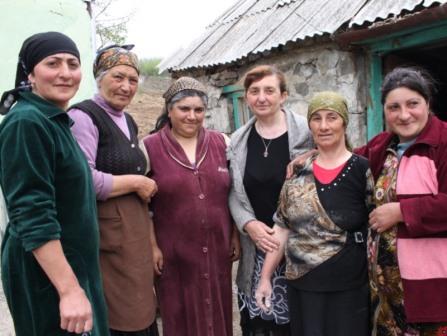
The village of Kamarlo is located next to the picturesque Lake Yaguflo. A worn-down road leads to the village located eight kilometres from the town of Dmanisi. According to the last census in Georgia performed in 2002, the population of the village was 713 people; all of them ethnic Azeris. Pikria Abdulaeva is amongst the village’s residents. She belongs to both cultures. She is an Azeri from her father’s side and Georgian from her mother’s. Azeri is the language of the village. Pikria speaks Georgian and served as the interpreter for our visit. Our arrival in the village caused a stir and the women invited by Pikria started arriving at the home of Phanura Kurbanova. In the garden the women explained how they make kizyak or fuel for winter. First, cow manure is leveled to the same thickness and is left to dry. Later, it is cut into pieces with a shovel. The pieces are then stacked in a sunny and ventilated place where they will be left to dry through summer and autumn, until the cold weather begins. This process turns the material into fuel. Kizyak is often made by women and children. The women then listed every activity they had performed that day from making bread to tending cattle to putting up wallpaper. Shoes were removed to enter the house.
The women recounted their memory of state farms. “Now it is easier, because there are no state farms. We used to work from morning until night and then come home and continue working in the house. In autumn, sometimes they would give ten tons of potatoes to each family and we had to manage this ourselves, carrying them, drying them, loading them, selling them or storing them for winter”. But for others, the state farms are associated with better times. Guliaz Gajieva is over 100 years old. she herself asserts she is 112. “We worked a lot but it was good work. I was even invited into the Central Committee of the Party as a leading worker, once”. Guliaz used to milk cows.
The women were enjoying the conversation. First, they maintained the attitude that “everything is good” and did not talk about problems. Gradually, however, they opened up. Out of the ten women who articipated in the conversation, four were divorced, half of them had lost husbands or sons, two women were married at the age of 14 and one of them had been bride-kidnapped. Often, women are complicit in these kidnappings. Gulazar was kidnapped as a bride for Pikria’s (her now mother in law’s) cousin. She was 14 and the groom was 26. Now Gulazar and Pikria share the same last name and are on good terms with each other, despite Pikria’s involvement in the kidnapping 17 years ago. Gulazar gave birth when she was 17. She had the baby in Baku and told the doctor about the circumstances surrounding her marriage. The Doctor sent a message to the village, saying “one of your young girls was forced into marriage at the age of 14! Take some measures!” The young husband could easily have been brought to justice for the forced marriage but they managed to avoid this through the help of some acquaintances in the right places. “Why didn’t you spare the girl?”, we asked Pikria. “Why?”, she answers. “Now, she has such a handsome husband who is the representative of the rural council”. Gulazar, who was listening, laughed along with the story as well.
The other women related stories of their marriages. Kheyala had not been bride-kidnapped but, rather, was matched with her husband when she was 14. She lived in the neighbouring village of Salamalik where there only was an elementary school which did not take her beyond the fourth grade. Before marrying, she lived with her parents where she looked after the household. She says, “If we had had a better school, then maybe they would not have married me off at such early age”. Kheyala has three children and added that three children are enough and that she will not let her daughter marry before she turns 19 or 20.
The issue with daughters is a critical one. On the one hand, the mothers do not want their daughters to have the same lives they did. On the other, they see that it is not easy to change the situation.
Alida Nasibova is 42 years old. She related the hard story of her divorce ten years ago. Alida is now raising her only child, a daughter. Her ex-husband has since died. Alida works as a teacher of the lower grades in the village school and provides every incentive she can to her daughter to study. She has big hopes that she will be able to change her life by getting an education. Pikria works at the village school as a teacher of Georgian. She says that the attendance of younger students is much better than the attendance of the older ones. Pikria says that her son is the only graduate who is continuing his education in Tbilisi. The majority of school graduates do not continue their studies.
 |
 |
Villagers travel to Baku fairly often, not for education but to visit relatives or for short-term work. Migration within Georgia is hampered by the language barrier which means that they do not travel much to other districts in Georgia. Phanura is a widow of over a year and wears a mourning kerchief and almost never smiles but she is quick, responsive and open and does everything quickly and silently. For her guests she made khinkali which consisted of thinly rolled boiled dough with butter and a sauce made from sour milk with herbs and spices. Sakna Gajieva is Phanura’s neighbour who came to speak with us briefly before getting back to baking bread at her house. She gave us hot bread for the way back and Phanura gave us some cheese as well. We were very touched by their hospitality, help and openness.

Publishing the following series of stories is an attempt to highlight the ethnic diversity of Kvemo Kartli. We are going to tell you the stories of five women living in various parts of Kvemo Kartli; these women have different lifestyles and represent different cultures, but they still have a lot in common. This is their history in stories. Stories of work, endurance, taboos, restriction, dignity, honesty and womanhood. You will not see figures and percentages here; this is not a quantitative survey. These are stories that allow us to build on those figures and percentages and enable us to develop profiles of Ajarian, Svan, Azeri, Armenian, Greek and local Georgian women’s lives, to understand their complexities and areas of commonality and to reflect this in our work as a programme.
Kvemo Kartli is one of the most ethnically diverse regions of Georgia. Ethnic diversity has developed over centuries and many contrasts and cultural differences have accumulated in this region; the study and management of these contrasts and differences and the development of models for peaceful cohabitation is not an easy task. Cultural, ethnic and language differences can be seen in every detail of life. Differences are present in rural and urban areas, in highlands and lowlands, in methods of doing business. Our objective in recording these stories was to attempt to create a profile of these women, to listen to them and build the picture of their lives, to understand the effects that culture and ethnic origin have on their lives, to see what opportunities they have and how they use or fail to use these opportunities, if they have them at all.
 |
|
|
|
|
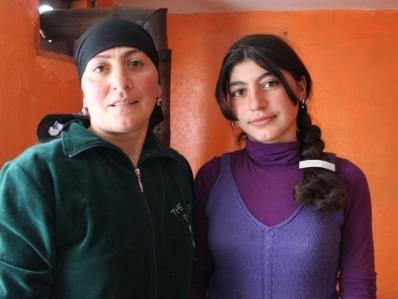
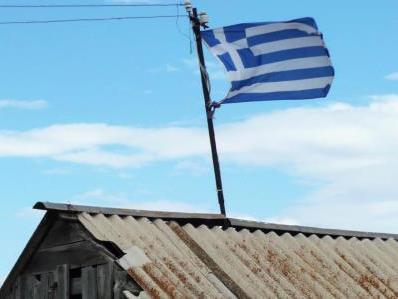
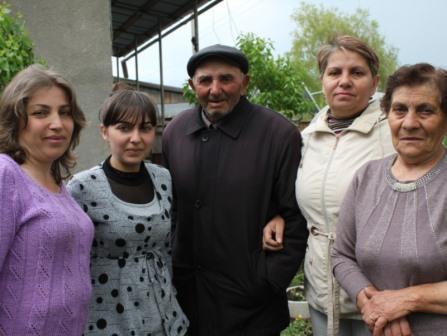
Armenians have been living in Kvemo Kartli for centuries. According to the 2002 census 31,777 out of 497,530 Kvemo Kartli residents were Armenians. The number of Armenians is highest in Tsalka where 11,484 Armenians live, out of a total population of 20977. The advent of Armenians in Georgia was related to the movement of people during the Arab, Turk-Seljuk, Mongolian, Turkmen, Kizilbash, Ottoman Turk and other invasions. Several major settlements of Armenians took place in 1828-1829, during the Russian-Turkish war
In 1980’s the planned settlement of a large groups of eco-migrant Ajarians and Svanetians started in Tetritskaro and Tsalka municipalities. There were several streams of eco-migration up to 2003. The advent of these incomers has left its mark on Kvemo Kartli. It became richer from an ethnic, religious and language standpoint, however it also gave rise to new problems and challenges for new and old residents alike in seeking to adapt to the new cultural diversity.
The first settlement of Svans into Kvemo Kartli took place in 1987. This is when the Svans from landslide-affected Chviberi (higher Svaneti) were resettled in Dmanisi, in the houses built under a government programme. Svans started to introduce their style of life in Kvemo Kartli and establish strong communities in Kvemo Kartli.
In 2011 Alliances KK facilitated establishment of DRR Municipal Working Groups in Dmanisi, Tsalka and Tetritskaro municipalities. These groups remain to be the main point for planning and implementing of prevention measures to reduce livestock related disaster risks.



