



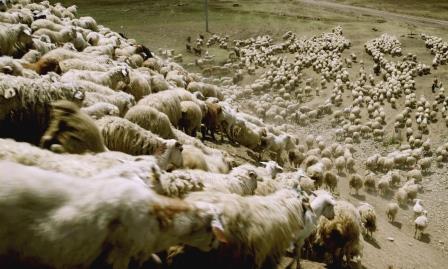
The villagers of Tsintskaro village have suffered for years from the twice yearly flow of more than 100,000 sheep, cattle, goats, donkeys, horses and shepherd dogs straight past their gates. The problem has been in impasse for years with no real ownership of the issue by the myriad actors involved. Now, the local government has spearheaded the movement to solve the problem calling together support from a group including the MOA, MOE, the Regional Government and Shepherds Association which has been working for three years to improve coordination and bring the matter of the Animal Movement Route to public attention.
Transhumance is a major part of the livestock system for sheep and to a lesser extent cattle in Georgia. Approximately 300,000 animals move twice yearly, up to summer pasture and back down to winter pasture on long established routes in spring and early autumn. For residents of Tsintskaro Village, Tetritskaro municipality this has meant living with a three week long flood of animals moving through the village. The route usually passes around settlements but a rocky ravine has meant that there was no access for the flocks other than the main road through the village. The obstruction, noise and dirt makes life intolerable for the villagers who can barely leave their homes and it is far from pleasant for the Shepherds and animals themselves as they are harassed by beeping cars as they move through flock after flock as quickly as they can.
The issue was recently publicized in the Eco Films Documentary ‘The Road’ (please follow the link) which has further publicized the plight of the village, the problems encountered by the Shepherds and the importance of the route and the movement of animals for the agricultural sector in Georgia. Luckily excellent coordination, the result of years of facilitation between local government, regional government, relevant Ministries, the private sector and the Shepherds Association through a regional Advisory Committee, has led to the commencement of work on a 4150 meters long, bypass route.
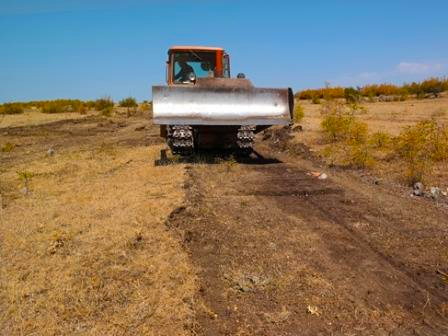
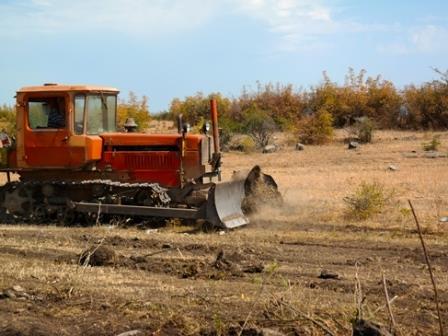
The work will include removing vegetation and establishing a road through the rocky ravine as well as signposting the route and fencing crop land to protect it from the herds. The work is expected to be completed by early October hopefully in time for the winter migration back down from the high pastures. An opening ceremony will be held to which media and all those involved in making the project happen will be invited. The solution to the Tsinskaro Problem which was considered for years one of the most intractable problems in the wider context of the AMR will give hope to many and marks the beginning of a regeneration of the AMR, a vital lifeline of the livestock system in Georgia.
Armenians have been living in Kvemo Kartli for centuries. According to the 2002 census 31,777 out of 497,530 Kvemo Kartli residents were Armenians. The number of Armenians is highest in Tsalka where 11,484 Armenians live, out of a total population of 20977. The advent of Armenians in Georgia was related to the movement of people during the Arab, Turk-Seljuk, Mongolian, Turkmen, Kizilbash, Ottoman Turk and other invasions. Several major settlements of Armenians took place in 1828-1829, during the Russian-Turkish war
Azerbaijanis living in Kvemo Kartli are Turkic-speaking people representing the legacy of the conquerors that came to this area at different times. in the 1926 Census they were referred to as Azerbaijanis. The Azeri population that settled in Kartli is comprised of two streams of migrants: 1. The Turkish-speaking population that was resettled between 15th-18th centuries; they went through the heaviest psychological and physical stress before they adapted to the new place. 2. Migrants who moved from one place to another to improve living conditions having adapted to the new environment. Currently the Azeri population in Georgia numbers 224,606. They mainly reside in Bolnisi, Dmanisi, Gardabani and Marneuli districts, mostly in district centers apart from in Dmanisi muniiciaplity where there are many Azeri villages. Some live in Tetritskaro and Tsalka districts.
In 1980’s the planned settlement of a large groups of eco-migrant Ajarians and Svanetians started in Tetritskaro and Tsalka municipalities. There were several streams of eco-migration up to 2003. The advent of these incomers has left its mark on Kvemo Kartli. It became richer from an ethnic, religious and language standpoint, however it also gave rise to new problems and challenges for new and old residents alike in seeking to adapt to the new cultural diversity.
The first settlement of Svans into Kvemo Kartli took place in 1987. This is when the Svans from landslide-affected Chviberi (higher Svaneti) were resettled in Dmanisi, in the houses built under a government programme. Svans started to introduce their style of life in Kvemo Kartli and establish strong communities in Kvemo Kartli.
In 2011 Alliances KK facilitated establishment of DRR Municipal Working Groups in Dmanisi, Tsalka and Tetritskaro municipalities. These groups remain to be the main point for planning and implementing of prevention measures to reduce livestock related disaster risks.



