



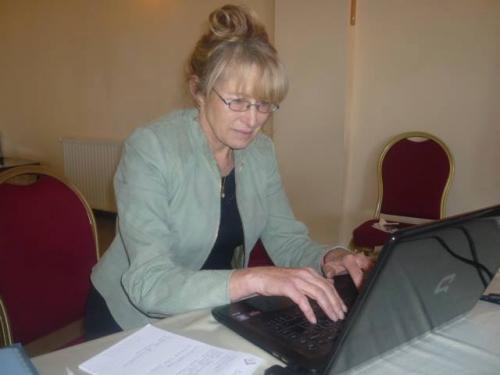
Heather Briggs, agronomist, agro-consultant on plant productivity, international expert on cheese and journalist visited Tbilisi to hold the training for agro-journalists last week. ‘Batumelebi’ newspaper interviewed her.
- Mrs. Briggs, what challenge do you see in Georgian agriculture?
- The first challenge is the perception of farming. I think the farming has to be made more professional and has to be recognized as a profession. People must be proud of what they do.
- The Government has started working on developing cooperatives in Georgia. How possible do you consider to develop cooperative farming in Georgian?
- This is a very difficult question. If people working for cooperatives will manage to work as a team, I think this can be a good idea. But I don’t know how Georgians perceive cooperatives, because they were very badly managed at Soviet time and this experience can influence on the development of cooperative system today.
- What will be your advice for improving farming in Georgia from European experience?
- I thing first of all, the farmer needs to understand some new techniques. The farmer needs to be open for improving and see that from using new technics they can benefit and they can make better living. I do not think that to be a successful a farm has to be a big. The farming should be profit oriented.
- How can traditional farming be transformed into modern farming?
- This takes time. You must give the farmers time to adapt. You must inspire them, so they want to learn.
- Who has to inspire farmers?
- Everyone must work together in Georgia for success. I think, consumers, regulations, but I think the main area of information must come from the press. The role of agricultural press is to do knowledge transfer.
- How long is a process of improving breeds in agriculture and for reaching the good results?
- It takes a long time and this is going to take several generations. What you do not need to do is bringing unsuitable breeds from elsewhere. The breed must be able to thrive in Georgia.
- What can you say about brucellosis, there are lots of cases of this disease identified in Georgia?
- Brucellosis is a disease that requires professional approach from the government of the country: to set up a programme of testing, monitoring and slaughtering animals with brucellosis. Your Minister has mentioned positive steps, including considering some compensation for those people who lose their cattle through brucellosis.
- What about the role of agriculture in the economy, do you think that small farmers can have an impact on economic development?
- Agriculture is vital and has one of the main roles in economic development. Small farmers, big farmers they all contribute in this process. I think one of the main challenges is that farmers need to start planning, they need to know what they are doing and for this they need education, information. One of the main sources of this information and knowledge is agricultural press.
- How do you see Georgian Agriculture from the point of view of politics?
- Politics and Agriculture – they need to work close together. Georgian needs to be one team. Politics, economy, agriculture - if you do not works together you will not get anywhere.
- Considering the reality of Georgia, what is a first thing we should do?
- Consolidate and work together.
The interview is prepared by “Batumelebi" newspaper
February, 2015
Armenians have been living in Kvemo Kartli for centuries. According to the 2002 census 31,777 out of 497,530 Kvemo Kartli residents were Armenians. The number of Armenians is highest in Tsalka where 11,484 Armenians live, out of a total population of 20977. The advent of Armenians in Georgia was related to the movement of people during the Arab, Turk-Seljuk, Mongolian, Turkmen, Kizilbash, Ottoman Turk and other invasions. Several major settlements of Armenians took place in 1828-1829, during the Russian-Turkish war
Azerbaijanis living in Kvemo Kartli are Turkic-speaking people representing the legacy of the conquerors that came to this area at different times. in the 1926 Census they were referred to as Azerbaijanis. The Azeri population that settled in Kartli is comprised of two streams of migrants: 1. The Turkish-speaking population that was resettled between 15th-18th centuries; they went through the heaviest psychological and physical stress before they adapted to the new place. 2. Migrants who moved from one place to another to improve living conditions having adapted to the new environment. Currently the Azeri population in Georgia numbers 224,606. They mainly reside in Bolnisi, Dmanisi, Gardabani and Marneuli districts, mostly in district centers apart from in Dmanisi muniiciaplity where there are many Azeri villages. Some live in Tetritskaro and Tsalka districts.
In 1980’s the planned settlement of a large groups of eco-migrant Ajarians and Svanetians started in Tetritskaro and Tsalka municipalities. There were several streams of eco-migration up to 2003. The advent of these incomers has left its mark on Kvemo Kartli. It became richer from an ethnic, religious and language standpoint, however it also gave rise to new problems and challenges for new and old residents alike in seeking to adapt to the new cultural diversity.
The first settlement of Svans into Kvemo Kartli took place in 1987. This is when the Svans from landslide-affected Chviberi (higher Svaneti) were resettled in Dmanisi, in the houses built under a government programme. Svans started to introduce their style of life in Kvemo Kartli and establish strong communities in Kvemo Kartli.
In 2011 Alliances KK facilitated establishment of DRR Municipal Working Groups in Dmanisi, Tsalka and Tetritskaro municipalities. These groups remain to be the main point for planning and implementing of prevention measures to reduce livestock related disaster risks.



