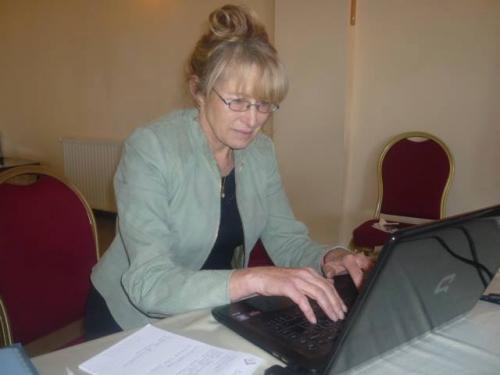
Heather Briggs, agronomist, agro-consultant on plant productivity, international expert on cheese and journalist visited Tbilisi to hold the training for agro-journalists last week. ‘Batumelebi’ newspaper interviewed her.
- Mrs. Briggs, what challenge do you see in Georgian agriculture?
- The first challenge is the perception of farming. I think the farming has to be made more professional and has to be recognized as a profession. People must be proud of what they do.
- The Government has started working on developing cooperatives in Georgia. How possible do you consider to develop cooperative farming in Georgian?
- This is a very difficult question. If people working for cooperatives will manage to work as a team, I think this can be a good idea. But I don’t know how Georgians perceive cooperatives, because they were very badly managed at Soviet time and this experience can influence on the development of cooperative system today.
- What will be your advice for improving farming in Georgia from European experience?
- I thing first of all, the farmer needs to understand some new techniques. The farmer needs to be open for improving and see that from using new technics they can benefit and they can make better living. I do not think that to be a successful a farm has to be a big. The farming should be profit oriented.
- How can traditional farming be transformed into modern farming?
- This takes time. You must give the farmers time to adapt. You must inspire them, so they want to learn.
- Who has to inspire farmers?
- Everyone must work together in Georgia for success. I think, consumers, regulations, but I think the main area of information must come from the press. The role of agricultural press is to do knowledge transfer.
- How long is a process of improving breeds in agriculture and for reaching the good results?
- It takes a long time and this is going to take several generations. What you do not need to do is bringing unsuitable breeds from elsewhere. The breed must be able to thrive in Georgia.
- What can you say about brucellosis, there are lots of cases of this disease identified in Georgia?
- Brucellosis is a disease that requires professional approach from the government of the country: to set up a programme of testing, monitoring and slaughtering animals with brucellosis. Your Minister has mentioned positive steps, including considering some compensation for those people who lose their cattle through brucellosis.
- What about the role of agriculture in the economy, do you think that small farmers can have an impact on economic development?
- Agriculture is vital and has one of the main roles in economic development. Small farmers, big farmers they all contribute in this process. I think one of the main challenges is that farmers need to start planning, they need to know what they are doing and for this they need education, information. One of the main sources of this information and knowledge is agricultural press.
- How do you see Georgian Agriculture from the point of view of politics?
- Politics and Agriculture – they need to work close together. Georgian needs to be one team. Politics, economy, agriculture - if you do not works together you will not get anywhere.
- Considering the reality of Georgia, what is a first thing we should do?
- Consolidate and work together.
The interview is prepared by “Batumelebi" newspaper
February, 2015
A few days ago all Self-Governing cities and municipalities in the country received a recommendation from the Ministry of Regional Development and Infrastructure to appoint an advisor on Gender Equity in each one to support implementation of the Law on Gender Equality 2010 and the action plan.
Two cases of Anthrax were identified in Tsalka Municipality during August 2013. According to the NFA representative Jemal Dekanadze, one cow died due to contracting Anthrax in Beshtasheni Village, Tsalka on August 8th. A blood test sent to Tbilisi Veterinary laboratory was confirmed positive for Anthrax. However, as reported by the Local Independent Vet from Tsalka Municipality, about 5 heads of dead cattle with clinical signs of Anthrax that were not laboratory tested were also observed in the local farms of the village.
Two cows died and a man has been infected due to contracting Anthrax in Patara Toneti Village, Tetritskaro Municipality. According to the representative of the NFA – Shota Poilarashvili the first cow died on July 17th, although the blood samples for laboratory testing were taken only by July 26th. During ten days the infected carcass had been abandoned in the ravine of the village.
Following on from the meeting with Shorena Bziava on May 21st in Kutaisi, Alliances KK met with Davit Narmania, the Minister of Regional Development and Infrastructure of Georgia. The main purpose of the meeting was introducing the Minister with Women’s Room, a new municipal service in Dmanisi, Tetritskaro and Tsalka municipalities, facilitated by the Alliances KK programme. Mr. David was informed about the main idea of WR and the services offered there. The information about the activities, the events carried out and the number of visitors since the establishment of WRs – were also overviewed. GENDER GUIDELINS for VILLAGE REPS with flyers of Women’s Room and Newsletter were presented and discussed.
Two cows died due to contracting Anthrax in Useinkendi, Karabulakhi Community, Dmanisi municipality on 13th May 2013. As the deputy of Gamgebeli Dato Petviashvili stated, a blood sample was taken from only one dead cattle and Tbilisi Veterinary Laboratory has subsequently confirmed the animal death was caused by Anthrax. The local government put Karabulakhi under quarantine for two weeks. The NFA commenced mandatory vaccination in the village and approximately 250 heads of livestock were vaccinated.
On 21st of May a meeting was held with Shorena Bziava, Gender Equality Council secretary at Georgian Parliament in Kutaisi. Alliances KK representatives introduced the programme Gender activities - a new municipal service Women’s Room and Guidelines for the Village Reps.