



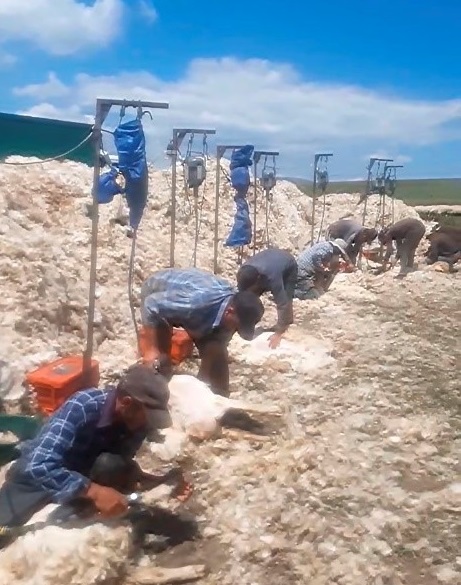
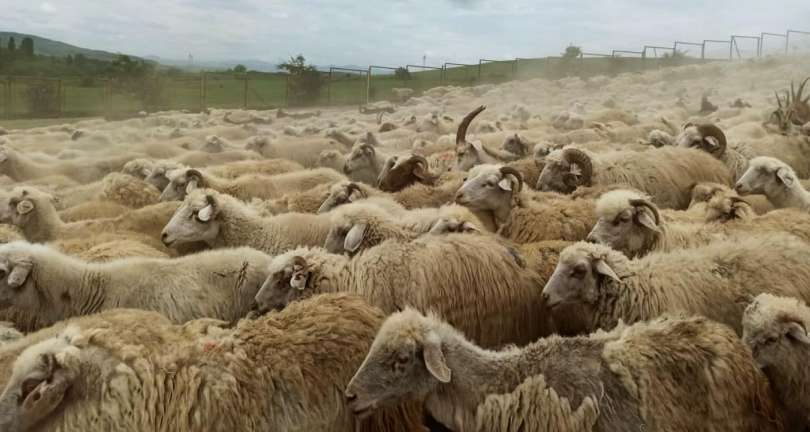
In 2018, while thinking about improving the quality of supplied wool, the Georgian Wool Company purchased twelve sheep shearing machines and trained a group of twelve shepherds, to provide a shearing service to sheep farmers. The service is available on the pastures at the beginning of spring and at the end of summer, when sheep are usually sheared in Georgia. This year, up to five-hundred farmers were served, with hundred thousand sheep sheared.
Before, the wool suppliers of the company sheared sheep by hand, which damaged wool fiber and the quality of wool was poor. It took time with only up to thirty sheep sheared a day. The sheep farmers had to ensure the workforce for shearing by hand, they also had to arrange wool storage space in pastures and transportation of wool from pastures to wool collection centers. Incompliant shearing and storage was decreasing the quality of wool and causing about a ten percent loss (up to thirty kilos), which was usually left on pastures polluting the local environment.
Now, the sheep shearing machines prevent damaging of wool fiber and respectively, the quality of wool has been improved. The company’s sheep shearing machine service includes storage and transportation of wool from pastures to the company`s warehouse in Tbilisi. Sheep shearing is now time-efficient with up to hundred sheep/day sheared by one trained shepherd. While shearing of thousand sheep by hand took at least three days, now the same is done just in one day. For the company it means a stable supply of wool in better, cleaner quality; For farmers it translates into reduced transaction costs, time and about 0.7 Gel saved per sheep.
The Georgian Wool Company first exported wool to the United Kingdom back in 2016. Ukraine, Kazakhstan, India, Afghanistan are now among top wool export destinations. Along with growing demand, improving quality has become a particular interest of the company.

The Memorandum of Understanding was signed between the Minister of Agriculture, the National Food Agency and SDC funded, Mercy Corps Georgia implemented ALCP on March 31st 2015. Within the framework of this memorandum ALCP will facilitate the building of two Bio-security yards with water points on the Animal Movement Route in Kvemo Kartli region, another three Bio-security yards will be financed from the State Budget.
The advisors from 5 municipalities of Ajara were trained on how to increase women participation in community meetings. Following the training facilitated by ALCP AJ, they worked with the Village Representatives and as a result of their activities, the attendance of women in these meetings has increased by 10-15%.
Very soon the Kvemo Kartli Region will have a new regional mechanism for Disaster Risk Reduction implemented by Local municipalities and the Kvemo Kartli Governor’s office. The Governor of Kvemo Kartli Paata Khizanishvili discussed this topic with the Gamgebelies of the region, deputy governors, the Mayor of Rustavi City and representatives of Alliances Lesser Caucasus Programme (ALCP) on March 11, 2015. The importance of regional coordination and the necessity of creating working groups in all municipalities were highlighted during the meeting.
The Advisory Committee was established in Ajara, which is supposed to be a forum for regional players representing national, local and regional government, civil society and the private sector to tackle key issues in agriculture sector. The participants discussed the role of the Self-governments in Disaster Risk Reduction, wildlife related issues in the region and also clarified the functions of the newly formed Municipal DRR Working Group in five municipalities of Ajara.
A kindergarten was opened on February 17th in Boslebi Village, Dmanisi municipality as a result of facilitation by the Dmanisi Women’s Room. The Kindergarten will serve 30 children not only Georgians from Boslebi Village but also from neighbor Kakliani Village which is mainly inhabited by Azeris. Four local women will be employed there.
From the ISET Economist news (http://www.iset.ge/news/?p=4633)
By Eric Livny
The “do no harm” (primum non nocere) principle is well known to students of medical schools. It is one of the most fundamental maxims in medicine, as formulated, for example, in the Epidemics book of the Hippocratic Collection:
“The physician must … have two special objects in view with regard to disease, namely, to do good or to do no harm“.
Doctors are taught that medical interventions are not risk-free. Thus, when facing a “problem” one should consider whether to use a particular procedure (e.g. surgery or chemical treatment) or do NOTHING.
Not surprisingly, this very principle has applications in many fields other than healthcare. And it is high time for this principle to be studied and applied in Georgian policymaking.



