



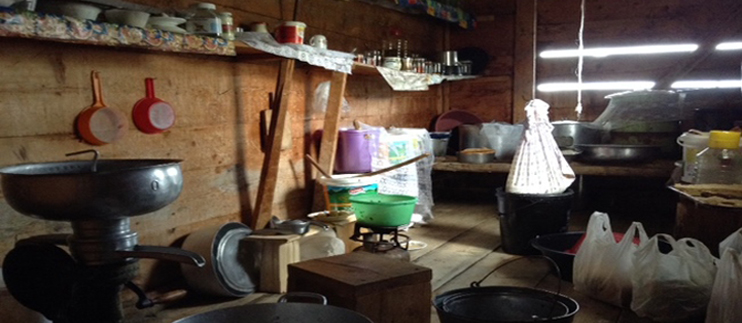
Name: Natural Produktsia Ltd
Place: Dioknisi Village, Khulo Municipality
Type of business: Cheese Factory
Product: Imeruli Cheese
Suppliers: about 450 women from 13 villages of Khulo
Current production per day: 5 tons of milk (700 kg of cheese)
The Problem
The 450 women now selling milk directly to the milk collectors of the Natural Produktsia Ltd Factory in Dioknisi, Khulo used to make cheese from their milk. Women are responsible for milking the household cattle and making the cheese, butter, sour cream and cottage cheese which is then sold as an important part of the family’s livelihood.
Selling these products however is hard and uncertain. The journey by marshutka to Batumi Agrarian Market can take up to 4 hours on bad roads. It is taken to the market by husbands or other male family members or sent with the driver and met by a relative who then tries to sell it. There is no guarantee of a sale and often the family is forced to accept a low price from the market vendors rather than take it home again.
The Idea
The idea for the factory came from a member of an old Khulo farming family, Arcadi. His brother, Tsezari was already in the dairy business in Tsalka with his mother, where, hoping to escape the lack of opportunity in Khulo they moved to Kvemo Kartli and started a small cheese factory in a cowshed. This cowshed is now a purpose built factory with its Sulguni cheese supplying Carrefour and the 5 star hotels of Batumi. Alliances KK had helped them do it. Arcadi was already selling his brother’s Sulguni cheese from the familiy’s distribution outlet in Batumi Market, but Sulguni only makes up 20% of the market the other 80% is for Imeruli. When Alliances opened in Ajara in 2014, Arcadi saw his chance. He proposed a small factory collecting milk from the upper mountain villages making Imeruli cheese. The gamble was that Imeruli sells for 2 lari less per kilo than Sulguni and you have to make and sell a lot more of it to make a profit.
The Solution
450 women are now selling milk directly to the milk collectors of the Natural Produktsia Ltd Factory in Dioknisi, Khulo. The building which opened in September 2015 is compliant with the new food safety and hygiene requirements and equipped with, with new modern dairy equipment.
Milk collectors from the factory collect the milk daily from the women in their houses. The women were specially trained by a food safety consultant in producing clean milk. The women save two hours a day from not having to make cheese, they save the costs of wood or gas for heating the milk to make it and other materials such as pepsin. The family is saved the costs and time and worry of having to get to Batumi and sell the cheese.
The End and the Beginning
The programme and Arcadi were unsure of how much milk there would be. People had said how poor the little red Ajaran cow was, how despairing the rural population. Ajara however has a magic, special even to Georgia, when the news went out that the factory was open the villagers decided en masse to sell. Overnight more milk than anyone imagined was available. The factory is processing 5 tonnes of milk about 700kg of cheese a day at a time of year when many dairy factories are thinking of shutting down for the winter as milk supply dwindles until the following spring. They have turned milk away as they have yet the capacity to process more. Expansion is already on the cards. Of the cheese itself the fat content is high and the milk itself from the high mountain pastures of pristine Ajara. The cheese moreover is delicious. The queues out the door of Aracadi’s distribution outlet in Batumi Market and the fact it’s sold out by midday testify to that.
Locals, interested parties including the Minister of Agriculture of Ajara and tourists, in the height of the Batumi summer run enjoyed a new addition to the summer time calendar of events with the first Ajara Honey Festival on August 22nd on Batumi Boulevard. The festival was organized by The Beekeepers Association of Ajara, an entity belonging to the Ajara Chamber of Commerce and Industry.
Ajara is a major producer of honey in Georgia and the programme has completed a sector survey and commenced numerous interventions. The festival was a first step in promoting Ajara as a producer of high quality honey and developing a cohesive image of honey production in the region. Beekeeping in Ajara has been practiced for centuries and still includes the capturing of wild swarms and cultivating of honey in logs known as ‘Jara’.
The National Food Agency representatives met with entrepreneurs of honey and meat sectors in Kvemo Kartli and Ajara regions in July. The aim of the meetings was to inform local producers on the regulations and required standards for the quality production of meat and honey products in accordance with FS&H standards.
Food Safety and Hygiene in the Agrarian Market of Batumi was the main topic of the ALCP AJ Advisory Committee’s second meeting in Ajara region. The discussion concerned the incompliance of existing situation in Market with FS&H standards and possible risks derived from the meat and dairy products purchased there. Due to the importance and complexity of the issue, key market stakeholders such as representatives of Ajara Government, NFA and Agrarian Market participated in the meeting.
“Women in Georgia – Tradition and Contemporaneity” is a short documentary film prepared by ‘Netgazeti’ (online newspaper) about women living in Ghordjomi Community (Khulo Municipality, Ajara). Ghordjomi is one of the largest Muslim communities in Ajara and is known for its early marriage traditions, and other strict rules and attitudes towards women. The film describes the harsh daily routine of the women starting from 6 am in the morning with taking care of the cattle, children, household and the restrictions they face in daily life.
The ALCP AJ programme’s Focus Group Survey and Gender Analysis captured these issues and also noted the consequent effect on the participation of women in the decision-making processes at the community and local governmental levels which is chronically low.
The first meeting of the Regional DRR Working Group was carried out at the KK Governor Office.
The Governor of Kvemo Kartli - Paata Khizanashvili encouraged decision makers from all municipalities of the region to pay more attention on issues linked with Animal Disease Control, Pasture Usage and Disaster Risk Reduction. He noted that the municipal leaders should understand these are the issues of high importance and the new municipal working groups should have strong communication with the Governor’s office and with other municipalities of Kvemo Kartli.
By now, all seven municipalities of Kvemo Kartlli have DRR working groups coordinated by the regional government.
A new project “Closer to Nature” was launched by Batumi Botanical Garden facilitated by ALCP AJ to promote 165 school student’s involvement in biodiversity and environmental protection activities.



