



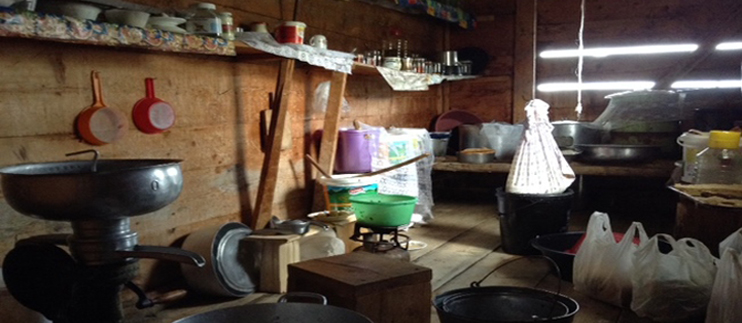
Name: Natural Produktsia Ltd
Place: Dioknisi Village, Khulo Municipality
Type of business: Cheese Factory
Product: Imeruli Cheese
Suppliers: about 450 women from 13 villages of Khulo
Current production per day: 5 tons of milk (700 kg of cheese)
The Problem
The 450 women now selling milk directly to the milk collectors of the Natural Produktsia Ltd Factory in Dioknisi, Khulo used to make cheese from their milk. Women are responsible for milking the household cattle and making the cheese, butter, sour cream and cottage cheese which is then sold as an important part of the family’s livelihood.
Selling these products however is hard and uncertain. The journey by marshutka to Batumi Agrarian Market can take up to 4 hours on bad roads. It is taken to the market by husbands or other male family members or sent with the driver and met by a relative who then tries to sell it. There is no guarantee of a sale and often the family is forced to accept a low price from the market vendors rather than take it home again.
The Idea
The idea for the factory came from a member of an old Khulo farming family, Arcadi. His brother, Tsezari was already in the dairy business in Tsalka with his mother, where, hoping to escape the lack of opportunity in Khulo they moved to Kvemo Kartli and started a small cheese factory in a cowshed. This cowshed is now a purpose built factory with its Sulguni cheese supplying Carrefour and the 5 star hotels of Batumi. Alliances KK had helped them do it. Arcadi was already selling his brother’s Sulguni cheese from the familiy’s distribution outlet in Batumi Market, but Sulguni only makes up 20% of the market the other 80% is for Imeruli. When Alliances opened in Ajara in 2014, Arcadi saw his chance. He proposed a small factory collecting milk from the upper mountain villages making Imeruli cheese. The gamble was that Imeruli sells for 2 lari less per kilo than Sulguni and you have to make and sell a lot more of it to make a profit.
The Solution
450 women are now selling milk directly to the milk collectors of the Natural Produktsia Ltd Factory in Dioknisi, Khulo. The building which opened in September 2015 is compliant with the new food safety and hygiene requirements and equipped with, with new modern dairy equipment.
Milk collectors from the factory collect the milk daily from the women in their houses. The women were specially trained by a food safety consultant in producing clean milk. The women save two hours a day from not having to make cheese, they save the costs of wood or gas for heating the milk to make it and other materials such as pepsin. The family is saved the costs and time and worry of having to get to Batumi and sell the cheese.
The End and the Beginning
The programme and Arcadi were unsure of how much milk there would be. People had said how poor the little red Ajaran cow was, how despairing the rural population. Ajara however has a magic, special even to Georgia, when the news went out that the factory was open the villagers decided en masse to sell. Overnight more milk than anyone imagined was available. The factory is processing 5 tonnes of milk about 700kg of cheese a day at a time of year when many dairy factories are thinking of shutting down for the winter as milk supply dwindles until the following spring. They have turned milk away as they have yet the capacity to process more. Expansion is already on the cards. Of the cheese itself the fat content is high and the milk itself from the high mountain pastures of pristine Ajara. The cheese moreover is delicious. The queues out the door of Aracadi’s distribution outlet in Batumi Market and the fact it’s sold out by midday testify to that.
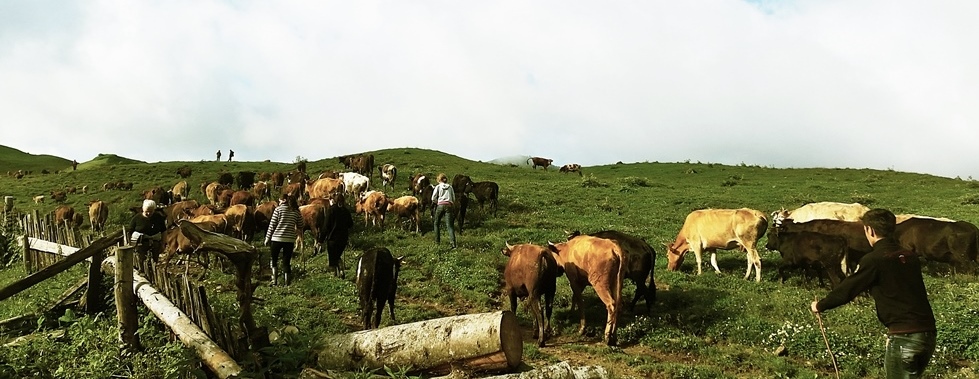
Heather Briggs, agronomist, agro-consultant on plant productivity, international expert on cheese and journalist visited Tbilisi to hold the training for agro-journalists last week. "Batumelebi" newspaper interviewed her.
For the first time in Georgia a training on agro journalism was conducted for media representatives wishing to report specifically on rural issues and news. The main purpose of the training was to fill knowledge gaps of media practitioners in crops, livestock husbandry and agriculture management and to introduce the basics of agro journalism. Heather Briggs, an international expert and member of British Guild of Agricultural Journalists - was invited to lead a 5 day training from January 26th to February 2nd. About 50 representatives of regional, national broadcasters and printed media participated in the event. The training was organized by the Georgian Regional Media Association and facilitated by the Alliances Lesser Caucasus Programme.
By Helen Bradbury: Team Leader, Alliances Lesser Caucasus Programme
We are in an interesting conundrum. Gender in most places has been written-in to law. Bar a few notable exceptions, every country in the world, has varying degrees of success in applying universal suffrage. Fifty countries are signed up to the CEDAW convention (the UN’s Convention on the Elimination of all forms of Discrimination Against Women). On the CEDAW world map of Discrepant Government Behaviour Concerning Women, the countries shaded dark green which denotes ‘virtually no enforcement of laws consonant with CEDAW or such laws do not even exist’, are where you expect them to be and in fact they are relatively few. It is the next two categories which disturb, covering the vast majority of the globe, the mid and lighter green, where laws are partly or fully consonant with CEDAW but there is little effective enforcement or spotty enforcement of them and the issue is low priority or hit and miss. After the gains, the laws and ratifications of the last centuries it seems that we must tread very carefully indeed for we must counteract indifference, in which inertia and inactivity stop us moving forward.
Government Momentum Builds on Animal Movement Route after the years of discussion and information exchange. The biggest challenge in Georgian sheep sector – the Animal Movement Route issue has come to the point when there is a willingness and concrete plan for taking actions and reaching tangible results.
The Eco Films LTD film The Road, commissioned by ALCP KK, was shown at the BIFED - Bozcaada International Festival of Ecological Documentary on October 31, 2014. The documentary was presented in the non-competition section and highly appreciated by the audience.
In October 24th the first flocks of migrating animals went through the newly arranged bypass route in Tsintskaro village, Tetritskaro Municipality. Testing of the new route was carried out successfully - sheep, cattle, horses, donkeys, dogs and shepherds passed on the new road without any difficulties. The movement was monitored by the Tetritskaro Municipality DRR WG members and the Tsintskaro village Rep.



